Kawasaki & Yokohama Rap: The Complete Guide — Why Kanagawa Has No Center [Rap Atlas]
Try to explain Kanagawa hip-hop as “one scene” and somewhere along the way you will be lying.
Yokohama, the port city, and Kawasaki, home to the Keihin industrial belt: the two have raised different sounds at different speeds.
Add SIMI LAB from Sagamihara and LEX and LANA from the Shonan coast, and you have a prefecture where at least four currents run side by side without ever merging.
This page maps all of it — from DS455 in 1989, to Tokyo Dome in 2024, to LANA standing on the Yokohama Arena stage in October 2025 — through a timeline and the defining artists.
It runs right up to the Kawasaki newcomer who topped Spotify’s viral chart in April 2026. Our inclusion criteria are published in full.
Yokohama Started in 1989, Kawasaki in 2003 — Two Origins, Fourteen Years Apart
Regional scenes like Tokyo, Osaka, or Okinawa usually have a center their story is told from. Kanagawa has none.
On the Yokohama side, the starting point is DS455, formed in 1989. “DS” stands for Dabstar; “455” comes from the phone number of MC Kayzabro’s home turf, Tsurumi — Yokohama’s 045 area code, minus its leading zero, plus the leading “5” of Tsurumi’s local exchange.
With DJ PMX behind the boards, the unit brought a West Coast, bayside aesthetic — shaped by the port and U.S. military culture — into Japanese rap.
In 1996, MACCHO — born in Isogo Ward, raised in Mutsukawa, Minami Ward — formed OZROSAURUS with DJ TOMO. Their 2001 album ROLLIN’045 became a long-selling record that topped 80,000 copies. From early on, Yokohama rap carried a sense of place that flew numbers and place-names as its flag.
The Kawasaki story starts later, and harsher. Fourteen years after DS455.
In 2003, SCARS formed in Kawasaki Ward around A-THUG, with SEEDA, BES, STICKY, and others. They came to be discussed as the first Japanese group to put hustling at the center of its subject matter.
Their 2006 release THE ALBUM reportedly placed second in the year-end awards of the music magazine blast (we have not yet re-verified the original source).
Same prefecture, adjacent cities — yet the sound, the language, and the reference points all differ. Trying to resolve that difference by asking “which one is the mainstream?” is the fastest way to misread Kanagawa.
Yokohama Claims “045,” Kawasaki Claims Ikegami-cho — Neighboring Cities, Different Ways of Naming Yourself
Claiming your hometown in a rap verse happened all over Japan. But what Yokohama flew was not a place-name — a phone number.
045 is Yokohama’s area code. Drop its leading zero and add the leading “5” of Tsurumi’s local exchange, and you have 455. The digits themselves became an ID card.
This is not wordplay. Phone-number boundaries track daily life more closely than administrative borders do. The digits mean nothing unless you have dialed them. A number that looks inert from outside works, on the inside, as proof of origin.
With DS455 and OZROSAURUS raising those digits in parallel, Yokohama rap established itself not as “next to Tokyo” but as a separate place called 045.
Put Kawasaki’s number beside it and the difference between the two circuits is instant.
Kawasaki’s area code is 044 — one digit off from Yokohama’s 045. Yet Kawasaki rappers never flew 044 as a flag.
What they put in their lyrics were not numbers but places: Ikegami-cho, Kawanakajima. Proper nouns far smaller than the city — a range you can cover on foot.
Yokohama named itself at the scale of the city; Kawasaki at the scale of the block. Two neighboring cities, and that much difference in how you point to where you’re from.
The instinct survives, transformed, in the later generations: SANTAWORLDVIEW from Honmoku, Tohji raised in the Kohoku New Town area of Tsuzuki Ward, ralph from Yokohama. They don’t claim numbers. But in one respect they are doing exactly what their predecessors did: they emerged without passing through Tokyo’s established routes.
Twenty-One Years From Kawasaki Ward to Tokyo Dome
On the Kawasaki side, the story runs in a straighter line.
In 2012, T-Pablow — from Kawanakajima, Kawasaki Ward — won the televised Koukousei Rap Senshuken (High School Rap Championship). It was the moment Kawasaki’s teenage rappers first drew national attention.
On March 25, 2014, BAD HOP formed, built around childhood friends from the Ikegami-cho area. The group took its name from the Kawasaki hip-hop event where they first performed.
What followed became, in itself, the touring history of Japanese rap.
November 13, 2018: a one-man show — Japanese industry shorthand for a solo headline concert — at Nippon Budokan, BreatH of South — roughly 8,000 people on a Tuesday night.
March 1, 2020: BAD HOP WORLD 2020 at Yokohama Arena, pushed through as a no-audience show at the onset of the pandemic — a decision reported to have left them deeply in debt.
And on February 19, 2024, they disbanded with BAD HOP THE FINAL at Tokyo Dome.
It was the first solo Tokyo Dome concert by a Japanese hip-hop act. Tickets were 9,900 yen (about US$65) and sold out completely on January 31, about three weeks before the show.
Attendance was roughly 50,000 (live report by the Japanese music-news site Natalie). All of it without ever belonging to a major label.
In October 2023, as tickets began to move, the group wrote on its official account (translated from Japanese):
“We have already set the all-time sales record for a Japanese hip-hop concert.”
That was four months before the show.
Count from the formation of SCARS and it is twenty-one years — the distance from a few square kilometers of Kawasaki Ward to Japan’s biggest venue, walked in full.
Timeline: Japanese Rap in Kanagawa, 1989–2026
| Year | Event |
|---|---|
| 1989 | Kayzabro (Tsurumi Ward) and DJ PMX form DS455. BAYSIDE RIDAZ (2000) and major debut Dabstar Clique (2002) establish the bayside / West Coast lane |
| 1996 | MACCHO and DJ TOMO form OZROSAURUS in Yokohama. ROLLIN’045 (2001) tops 80,000 copies |
| c. 1999 | SD JUNKSTA forms in Sagamihara; NORIKIYO, then producing as K-NERO, would go on to front the crew — the ground SIMI LAB would later build on |
| 2001 | DINARY DELTA FORCE forms in Fujisawa; since their 2010 debut SOUNDTRACK TO THE BED TOWN they have run the independent label DLiP RECORDS |
| 2003 | SCARS forms in Kawasaki Ward around A-THUG, with SEEDA, BES, STICKY |
| 2007 | OMSB, QN and others form SIMI LAB in “SIMI CITY” — the crew’s name for its Sagamihara home turf; Page 1 : ANATOMY OF INSANE (2011) earns national acclaim |
| 2011 | JJJ, KID FRESINO and Febb form Fla$hBackS |
| 2012 | T-Pablow (Kawanakajima, Kawasaki Ward) wins the High School Rap Championship |
| 2014 | March 25: BAD HOP forms around childhood friends from Kawasaki Ward |
| 2018 | November 13: BAD HOP’s solo Budokan show BreatH of South — about 8,000 people on a Tuesday night |
| 2020 | March 1: BAD HOP WORLD 2020 at Yokohama Arena, held without an audience |
| 2023 | K-Arena Yokohama opens; November 5: Awich‘s first arena show Queendom -THE UNION- there |
| 2024 | February 19: BAD HOP disbands with BAD HOP THE FINAL at Tokyo Dome — the first solo Tokyo Dome show by a Japanese hip-hop act, roughly 50,000 attendance (Natalie, ORICON NEWS, Japanese) |
| 2025 | February: Tohji’s first arena show at Pia Arena MM (about 10,000 people); April 1: LANA (Shonan) plays a solo Budokan show, 20 at BUDOKAN; September 23: STUTS’s Odyssey at K-Arena; October 5: LANA’s solo show at Yokohama Arena |
| 2026 | April: 27AM (Kawasaki) releases debut single Frozen Car; “PASSO” hits No. 1 on Spotify’s viral chart. August 11: BATTLE SUMMIT III at K-Arena Yokohama. October 25: YZERR’s FORCE FESTIVAL at Higashi-Ogishima East Park, Kawasaki |
The Defining Artists — Seventeen Acts, From DS455 to LANA
These are the seventeen acts we could verify against our inclusion criteria. They are listed in order of debut. The order implies no ranking; HIPHOPCs does not decide “who is number one.”
Artist profile pages are not yet published in English, so names appear without links here (links will be added as pages go live).
DS455 (Tsurumi Ward, Yokohama / 1989–)
The unit that opened the bayside / West Coast lane. DJ PMX, originally from Miyazaki Prefecture, carried the current as a central figure of the Yokohama scene.
Basis for inclusion: Criterion 2 (historical role confirmed across multiple sources) / Criterion 1 (major-distribution releases and national coverage)
OZROSAURUS (Yokohama / 1996–)
The act that made the nation learn Yokohama rap together with its emblem, “045.” MACCHO was born in Isogo Ward and raised in Mutsukawa, Minami Ward.
Basis: Criterion 2 / Criterion 1 (80,000+ copies of ROLLIN’045; music-press awards)
SD JUNKSTA (Sagamihara / c. 1999–)
The Sagamihara crew that NORIKIYO — who joined at formation as a trackmaker under the name K-NERO — went on to front; the act that laid the first layer of Sagamihara rap, years before SIMI LAB. NORIKIYO’s debut album EXIT (2007, YUKICHI RECORDS) placed third in the Japanese edition of THE SOURCE magazine’s “BEST OF JAPANESE RAP 2007.”
Basis: Criterion 2 (historical role in the Sagamihara scene; multiple independent sources incl. the Japanese hip-hop site Amebreak’s crew interview) / Criterion 1 (NORIKIYO’s official releases and specialist-media record)
DINARY DELTA FORCE / DLiP RECORDS (Fujisawa / 2001–)
The Fujisawa crew formed in 2001, and its independent label DLiP RECORDS (home to BLAHRMY — MILES WORD + SHEEF THE 3RD — and producer NAGMATIC). Since their debut album SOUNDTRACK TO THE BED TOWN (2010), they have kept building an underground foundation in Shonan that is entirely separate from the streaming-native generation.
Basis: Criterion 2 (sustained Fujisawa-based role; Spincoaster, Qetic, CDJournal, Tower Records features) / Criterion 1 (catalog on official streaming services)
OMSB (“SIMI CITY” — Sagamihara / 2007–)
The central figure of SIMI LAB, whose Page 1 : ANATOMY OF INSANE (2011) took the group national. The face of Kanagawa’s producer-craftsman lineage, distinct from the Kawasaki–Yokohama street lanes.
Basis: Criterion 1 (official streaming releases; sustained specialist-media coverage) / Criterion 2
JJJ (Kawasaki / 2011–)
Rapper and producer. Via Fla$hBackS, one of the artists who opened the road from Kawasaki into Tokyo’s underground.
Basis: Criterion 1
BIM (Kawasaki)
Through THE OTOGIBANASHI’S and CreativeDrugStore, a carrier of the crossover between hip-hop and indie/pop.
Basis: Criterion 1 (official releases, national media appearances, chart results incl. TV-drama themes)
T-Pablow (Kawanakajima, Kawasaki Ward / 2012–)
From High School Rap Championship winner to the center of BAD HOP; the man who made “Kawasaki” a nationally known proper noun.
Basis: Criterion 2 / Criterion 1
YZERR (Kawasaki Ward / 2014–)
BAD HOP’s strategist, now involved on the promoter side of the scene — including festival organizing — since the breakup.
Basis: Criterion 1 (official releases; national coverage incl. Forbes JAPAN) / Criterion 2
Tiji Jojo (Ikegami-cho, Kawasaki Ward / 2014–)
Still running solo after BAD HOP’s breakup, with a solo Nippon Budokan show announced (Japanese). Proof of Kawasaki’s continuity.
Basis: Criterion 1
Benjazzy (Kawasaki / 2014–)
Stacking solo work since the breakup; one of the acts set to carry Kawasaki’s next decade.
Basis: Criterion 1
SANTAWORLDVIEW (Honmoku, Yokohama)
Rapper and producer. Yokohama’s present tense, arrived at through both MC battles and SoundCloud.
Basis: Criterion 1
JP THE WAVY (Shonan, Kanagawa)
One of the most deliberate updaters of Japanese rap’s overseas connections.
Basis: Criterion 1 (official releases; national achievements incl. an MTV VMAJ win)
Tohji (Kohoku New Town, Tsuzuki Ward, Yokohama)
An emblem of the internet-born generation. In February 2025 he played his first arena show at Pia Arena MM in his hometown Yokohama — about 10,000 people — a show that reached theaters that June as Tohji Pia Arena: The Movie.
Basis: Criterion 1 (releases, national coverage, arena show)
LEX (Zushi, Shonan, Kanagawa)
One of the streaming-era centers of 2020s Japanese rap. With his seventh album Original, “LEX” has become less a rapper than a genre of his own (Japanese).
Basis: Criterion 1 (releases, festival headline slots, national coverage)
ralph (Yokohama)
The defining figure in planting drill and grime inside Japanese rap.
Basis: Criterion 1 (releases; coverage incl. overseas media such as Dazed)
LANA (Shonan, Kanagawa)
Headlined Nippon Budokan with 20 at BUDOKAN on April 1, 2025 — reported as making her the youngest artist in Japanese hip-hop to play a solo Budokan show. She stood on the Yokohama Arena stage that October 5.
Basis: Criterion 1 (releases; Forbes JAPAN 30 UNDER 30 2024; Budokan and arena shows)
We also publish our exclusion calls.
Vingo, a former BAD HOP member, is recorded in our database as being from Tokyo. Because we could not confirm a Kanagawa origin, he is not included on this page.
SCARS can be confirmed across multiple sources as “a group formed in Kawasaki Ward,” but the individual members’ hometowns cannot — so we treat them as a crew rather than as individuals.
Four Currents That Never Merge — Yokohama, Kawasaki, Sagamihara, Shonan
This is why Kanagawa cannot be told as one line. The prefecture holds at least four separate roads. The names are regional, but the currents are lineages, not postal districts — one area can hold more than one layer.
First, Yokohama’s bayside lane. Built up from the 1990s on a West Coast aesthetic flying the area code as its flag, against the backdrop of the port and U.S. military culture. Its center: DS455 and OZROSAURUS. DBL MUSIC, the label DJ PMX founded in 2018, carries the lane today.
Second, Kawasaki’s hustling / survival lane. The narrative that ran from SCARS to BAD HOP, grounded in the Keihin industrial belt and the living conditions of southern Kawasaki Ward. Its lyrics name Ikegami-cho and Kawanakajima — walkable place-names, where Yokohama named digits.
Third, the auteurist lane of the Sagamihara–Zama sphere. The SIMI LAB / OMSB lineage: formed in 2007, nationally recognized with Page 1 : ANATOMY OF INSANE in 2011. They entered the scene not through street narrative but through the sheer inventiveness of their tracks and song construction.
That soil, though, did not appear from nowhere in 2007. Around 1999, SD JUNKSTA — the crew NORIKIYO would come to front — laid the first layer of Sagamihara rap. But that is ground, not lineage: SD JUNKSTA’s storytelling leaned street, and SIMI LAB chose a different road on top of that soil. The third current, likewise, is not all of Sagamihara.
Fourth, the Shonan / internet lane. LEX, LANA, JP THE WAVY — plus, from the Yokohama side, Tohji, ralph, and SANTAWORLDVIEW. One thing in common: they skipped the traditional climb through Tokyo’s live houses — the small club venues where careers are conventionally built — and emerged directly from streaming and social media.
Shonan also holds an older layer that predates this streaming-native generation: DINARY DELTA FORCE of Fujisawa and their label DLiP RECORDS have been laying groundwork locally since 2001. The “fourth current” is not all of Shonan.
Four currents, running unmixed. That is why Kanagawa is not “suburban Tokyo.” It is a region holding multiple exits that bypass Tokyo simultaneously.
Of the four, the most overlooked is the third. Ask what “Kanagawa hip-hop” means and the answers usually stop at Yokohama’s bayside or Kawasaki’s BAD HOP.
But the omission is bigger than that. JJJ and BIM are also from Kawasaki — JJJ of Fla$hBackS, BIM of THE OTOGIBANASHI’S and CreativeDrugStore. Both left Kawasaki and made music entirely apart from the SCARS-to-BAD-HOP line.
The equation “Kawasaki = hustling” drops an entire auteurist lineage from the same city. Kawasaki is not a one-color town.
Not that the four lines never touch.
On September 23, 2025, STUTS held his first arena show, Odyssey, at K-Arena Yokohama. The guest list included T-Pablow and JJJ.
Kawasaki’s hustling lane, and the craftsman lane that left Kawasaki for Tokyo’s underground — two currents that had run separately inside the prefecture, on the same Yokohama arena stage for one night.
Crossings like that have happened only a handful of times.
Venues and Labels — From CLUB CITTA’ to K-Arena Yokohama
A scene does not move on people alone. Kanagawa has venues at every scale.
- CLUB CITTA’ (Kawasaki) — The long-running live house (small club venue) by Kawasaki Station; regarded as one of the main venues for Kawasaki hip-hop events (primary source unconfirmed)
- KT Zepp Yokohama — The step-up venue where nationally rising acts move into headline-show territory
- Yokohama Arena — Site of BAD HOP’s no-audience show in March 2020; LANA’s solo show on October 5, 2025
- Pia Arena MM — Tohji’s first arena show in February 2025, about 10,000 people, later a theatrical film
- K-Arena Yokohama — Opened 2023. Awich’s first arena show Queendom -THE UNION- that November 5; STUTS’s Odyssey on September 23, 2025
Among crews and labels, SCARS (2003), SIMI LAB (2007), Fla$hBackS (2011), BAD HOP (2014–2024), and DBL MUSIC (founded 2018) have each served as the vessel for a different lineage.
2026: K-Arena Yokohama in August, Open-Air Kawasaki in October
In Kanagawa now, locals standing on the region’s biggest stages has become the norm.
August 11, 2026: BATTLE SUMMIT III at K-Arena Yokohama — a 2-on-2 MC battle with a 50-million-yen (about US$330,000) grand prize.
The announced entrants include T-Pablow and Benjazzy, both out of Kawasaki — on different teams. Two men who once shared a crew will stand on opposite sides of a Yokohama arena.
October 25, 2026: YZERR’s FORCE FESTIVAL, at Higashi-Ogishima East Park in Kawasaki.
An event whose previous edition was held at Yokohama Arena moves outdoors to Kawasaki — YZERR, post-BAD HOP, returning to his hometown not as a performer but as the promoter. Dates and ticket details are in our full guide (English).
August in a Yokohama arena, October in open-air Kawasaki: two and a half years after the breakup, former BAD HOP members are involved in major events at both of the prefecture’s poles, in different roles.
The road since the breakup has not been smooth, though.
In July 2026, YZERR canceled three tour dates and T-Pablow delayed his album in the same week (Japanese).
Around the same time, BREATH — the apparel brand YZERR is involved in — announced a store in Shibuya’s Miyashita Park (Japanese). What comes out of Kawasaki now extends beyond recordings.
On the Shonan side, LANA remains the artist who keeps carrying the question “is she a rapper?” (Japanese).
One to Watch: 27AM (Kawasaki)
The emerging-artist slot currently holds exactly one act — the only one we could pass through our criteria with evidence: a release within the last 24 months, plus at least one of media coverage, competition, or festival appearance.
27AM (Kawasaki, Kanagawa). His name spread through RAPSTAR 2025, an audition program on the Japanese streaming service ABEMA.
In April 2026 he released his debut single Frozen Car — our review is here (Japanese).
The track “PASSO” reached No. 1 on Spotify’s viral chart and No. 2 on the buzz chart; the video passed 500,000 views in two weeks. A new single, “19,” followed on April 24.
The numbers came fast — from unknown to the top of national streaming charts in half a year.
Now look back at the timeline. In 2012, what pushed Kawasaki’s teenagers onto the national stage was a TV program, the High School Rap Championship. In 2025, what pushed 27AM out was RAPSTAR 2025 — another televised audition.
Thirteen years apart, the exit from Kawasaki has the same shape.
What differs is what waits after the win. When T-Pablow won in 2012, there was no national streaming stage ready to receive the winner — so his generation built its own crew, stacked its own shows, and walked twelve years to Tokyo Dome. For 27AM, Spotify’s charts were waiting the moment the program ended.
In thirteen years, Kawasaki’s route to the country changed from walking to riding. Arrival is fast now. The footing to stay is something each artist must still build alone.
That this slot holds only one act does not mean Kanagawa lacks emerging talent; it means our verification has not caught up. It is the top priority for the next update.
Inclusion Criteria for This Page, and How to Apply
Rap Atlas inclusion is decided only on criteria we can explain mechanically. In summary:
Defining artists are listed when either of the following holds:
- ① A release record on official streaming services, plus confirmed national media coverage, appearances, or chart results (specialist media included)
- ② A historical role in the regional scene confirmed by multiple independent sources
Ones to watch are listed with a release within the last 24 months plus at least one of: media coverage, competition results, or festival appearances.
Our operating principles are public as well:
- No rankings (listing order is by debut or syllabary; order carries no meaning)
- Regional attribution relies only on the artist’s own statements or credible reporting — we do not tie people to places by conjecture
- No unverified claims regarding criminal conduct or underworld ties
- Inclusion and order are never for sale (advertising and paid partnerships are handled entirely separately)
To apply for inclusion: if you are an artist or affiliate who meets these criteria but is not listed, contact us through the HIPHOPCs contact form with verifiable information (streaming links, records of media coverage). We will reflect it in the next update once confirmed.
A Rap Atlas page is not written once and abandoned. Kanagawa above all is a prefecture where four currents move at four speeds — this page is a record that keeps updating with them.
Addendum, July 28, 2026: following a reader’s submission through our inclusion-request channel, and after verification against our criteria, SD JUNKSTA (Sagamihara) and DINARY DELTA FORCE / DLiP RECORDS (Fujisawa) have been added, mirroring the Japanese edition of this page (published July 27, 2026). This is the first instance of this page working as what it promises to be — a record that keeps updating. We thank the reader.
Continue Exploring Kanagawa Rap
- YZERR: the BAD HOP architect who built a way out of Kawasaki
- T-Pablow: battle rap, BAD HOP and Kawasaki
- LEX: from SoundCloud to an arena plan
- JP THE WAVY: dance, rap, film and art from Shonan
- Tohji: Mall Boyz, u-ha and Tokyo Dome
- DJ SN-Z on OZROSAURUS, Harlem and Los Angeles
- Nakamura Minami: from homelessness to Forza Horizon 6
References (Japanese)
- https://natalie.mu/music/news/561755 — Natalie live report, BAD HOP at Tokyo Dome
- https://www.oricon.co.jp/news/2314818/full/ — ORICON NEWS on the Tokyo Dome show
- https://norikiyo.biz/profile/ — NORIKIYO official profile
- https://ja.wikipedia.org/wiki/DS455
- https://ja.wikipedia.org/wiki/DJ_PMX
- https://ja.wikipedia.org/wiki/OZROSAURUS
- https://ja.wikipedia.org/wiki/SCARS_(%E3%82%B0%E3%83%AB%E3%83%BC%E3%83%97)
- https://ja.wikipedia.org/wiki/SIMI_LAB
- https://ja.wikipedia.org/wiki/BAD_HOP
- https://ja.wikipedia.org/wiki/T-Pablow
- https://ja.wikipedia.org/wiki/YZERR
- https://ja.wikipedia.org/wiki/NORIKIYO
- https://www.dliprecords.info/
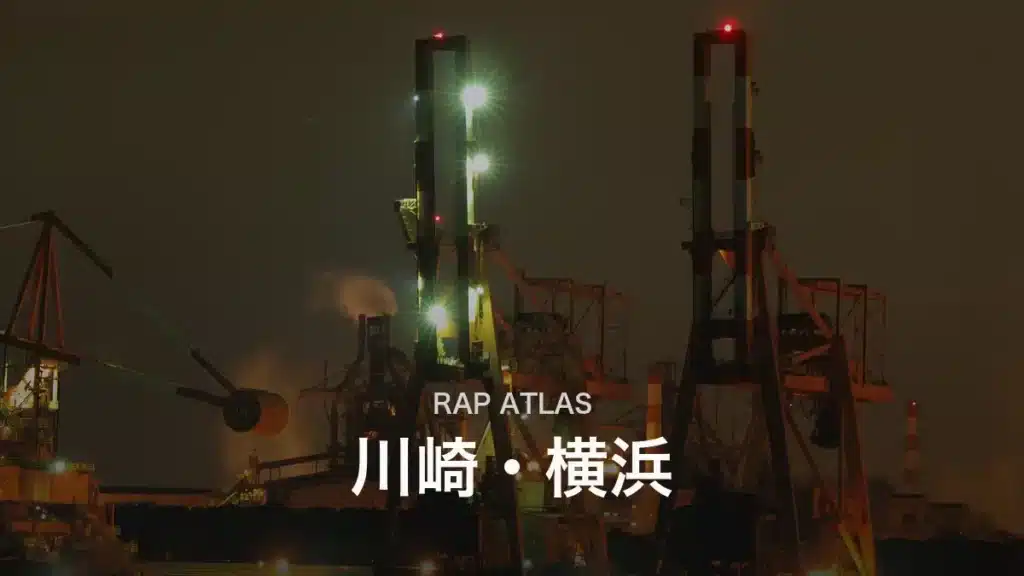
Featured image: Steel works at night, Ogishima, Keihin industrial zone (Kawasaki) — Photo by Kaz Ish / Wikimedia Commons, CC BY-SA 3.0 (cropped, tone-adjusted)
Frequently asked questions
- What is the Kawasaki and Yokohama rap scene?
- Kanagawa hip-hop has no single center. Yokohama's port culture and Kawasaki's industrial belt developed distinct sounds and narratives.
- Which acts define Kawasaki and Yokohama rap?
- DS455, OZROSAURUS, SD JUNKSTA, DINARY DELTA FORCE / DLiP RECORDS, OMSB, JJJ, BIM, T-Pablow, YZERR, Tiji Jojo, Benjazzy, SANTAWORLDVIEW, JP THE WAVY, Tohji, LEX, ralph, LANA. The Representative Artists section gives the source basis for every entry.
- Which labels and crews matter in Kawasaki and Yokohama?
- SCARS, BAD HOP, SIMI LAB, Fla$hBackS, DBL MUSIC. The article explains each role and its source basis.
- When does this article's timeline begin?
- The article's timeline begins with its 1989 entry: Kayzabro and DJ PMX formed DS455, whose name referred to Tsurumi Ward's telephone area code.
- How is this guide fact-checked?
- The guide cross-checks official announcements, artist interviews, municipal records and music reporting, and marks claims that remain unconfirmed.