About
Last updated: October 13, 2026 | Editorial lead: Nobuhiro Takahashi (Editor-in-Chief)
About HIPHOPCs
HIPHOPCs is a Japan-based publication that reads hip-hop in Japan and around the world through primary sources, original reporting, data, and criticism. Founded in 2024. We cover five areas: news, exclusive interviews, long-form analysis, fashion and culture, and data analysis.
We do not stop at what happened. We write why it matters, who it connects, and how it changes the way the scene looks. Translation and press material may inform reporting, but we do not present either as original reporting. Our purpose is to leave behind the context and the record needed to understand hip-hop from where we sit.
Our editors publish direct interviews as first-person testimony and distinguish them from reports about interviews conducted by other outlets. The formulas, scoring criteria, and limitations of our proprietary indices, HSI and HPCI, are published in full on dedicated methodology pages. Our sources, the scope of our AI use, our corrections process, our quotation policy, and the relationship between advertising, sponsorship, and editorial judgment are all stated on this page.
HIPHOPCs publishes in Japanese first. A selected portion of that work is available in English, and the English archive is expanding. Where a piece exists only in Japanese, we say so.
| Publication | HIPHOPCs |
| Type | Hip-hop news and criticism publication |
| Founded | 2024 |
| Published and edited by | The HIPHOPCs editorial team |
| Editorial lead | Nobuhiro Takahashi (Editor-in-Chief) |
| Reporting bases | Tokyo / Tokushima / Los Angeles |
| Languages | Japanese, with selected English coverage (Japanese edition) |
| Direct-interview archive | 57 published Japanese pages and 55 public English editions (inventory checked October 13, 2026). Counts include article parts and language editions, not unique people or interview sessions. |
| Frequency | News daily as it breaks, weekly hip-hop news every week, analysis and reports as completed |
| Ownership | No outside equity investment (as of August 4, 2026) |
| Proprietary indices | HSI (HIPHOPCs Scene Index) / HPCI (HIPHOPCs Production Constellation Index) |
What this page covers
- Why HIPHOPCs exists
- Transparency and editorial independence
- What we have actually published
- Four editorial areas
- Sources and editorial process
- Scope of AI use
- Corrections policy
- Quotations and images
- Editorial team
- Advertising, sponsorship and revenue
- Reader contact
- Frequently asked questions
- Publication information
Why HIPHOPCs exists
If all you need is what happened, social media will tell you. What HIPHOPCs writes is why an event matters, who it connects, and how it changes the way the scene looks.
Hip-hop is not only music. The brands rappers wear, the MCs walking luxury runways, the sneakers carrying a generation’s instincts, the language of a specific city, the visuals, the lifestyle that encodes a value system: several cultures cross to make the thing. HIPHOPCs reads all of those layers as connected context, not as isolated stories.
Social feeds show fragments. English-language coverage rarely connects to the history and instincts of the Japanese scene. Japanese domestic coverage rarely connects to what is happening globally. HIPHOPCs exists to close those three gaps.
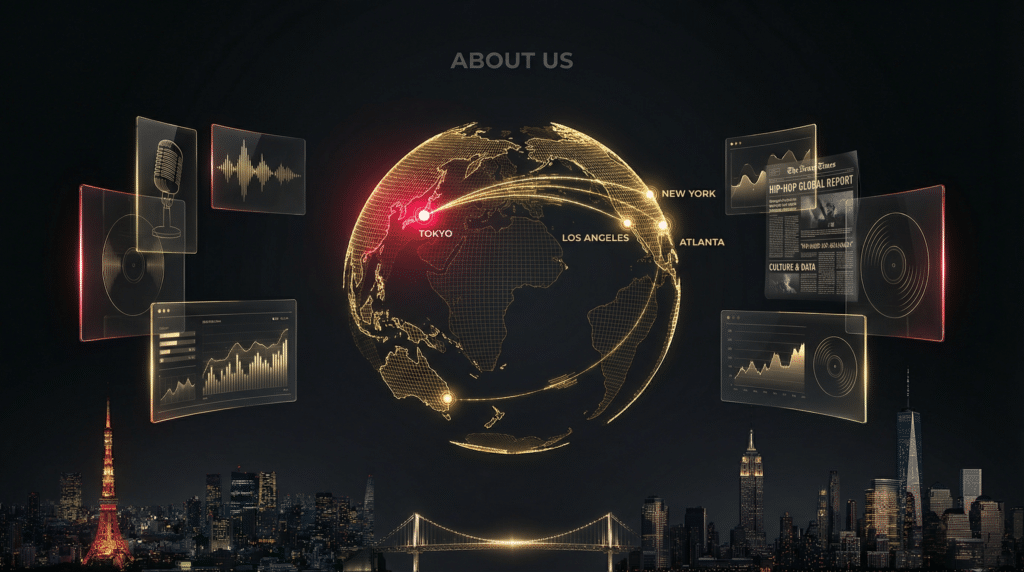
For readers outside Japan, this means something specific. The Japanese scene is larger, more regionally distinct, and more internationally connected than English-language coverage usually reflects. We report it from inside, with reporters in Tokyo, Tokushima, and Los Angeles. And on US and global stories, our judgment is calibrated by a desk that does not treat New York as the center of the world.
We check primary sources, ask the artists directly, dig into background, and verify with numbers. We refuse to leave fragments as breaking news, and turn them into a map of the scene. Then we leave that map as a record worth returning to years later. Updating the standard for how hip-hop is read is what HIPHOPCs is for.
Transparency and editorial independence
HIPHOPCs keeps the basis for its editorial judgment, and the location of responsibility for it, verifiable by readers. The standards we publish are listed below.
| Item | Our policy | Details |
|---|---|---|
| Editorial responsibility | The Editor-in-Chief holds final responsibility for editorial policy, publication decisions, and corrections | Editorial team |
| Sources | Official statements, artist posts, and label or management announcements take priority. We do not rely on anonymous sources alone | Editorial process |
| Confidence labels | In the weekly news, labels distinguish confirmed information, disputed claims, and unverified observation | Editorial process |
| Use of AI | Used for aggregation, visualization, structural drafting, and copy-editing. Reporting, interpretation, scoring, and publication decisions are made by editors. AI-generated images are labeled in the caption | Use of AI |
| Proprietary indices | The formulas, scoring criteria, and limitations of HSI and HPCI are published | HSI / HPCI |
| Corrections | Errors are corrected, and changes affecting a reader’s understanding are logged with the date, the change, and the reason | Corrections policy |
| Ownership | As of August 4, 2026, no outside company holds equity in HIPHOPCs, and no outside party can influence editorial policy through voting rights | Advertising, sponsorship and revenue |
| Advertising and sponsorship | Sponsors include businesses in the music and entertainment industry. Where a story touches a sponsor directly, the relationship is disclosed in the article. Paid content is labeled | Advertising, sponsorship and revenue |
| Quotations | We verify the legal requirements for quotation and do not treat attribution alone as a license to reuse | Quotations and images |
| Bylines | Articles carry a byline as a rule, and each writer’s work can be reviewed from their author page | Editorial team |
HIPHOPCs operates with the Editor-in-Chief as the final decision-maker. Advertisers, sponsors, and other funders do not decide what we cover, what we ask, how we evaluate it, how it ranks, how it scores on HSI, or whether it runs.
Editorial independence does not mean having no outside relationships. It means disclosing those relationships when they exist, refusing to let them reach editorial judgment, and leaving readers able to check the terms on which an article was written.
What HIPHOPCs has actually published
A statement of principles proves nothing on its own. The pieces below are available in English. A considerably larger archive of reporting, analysis, and criticism is published in Japanese, and translations are added as capacity allows.
Exclusive interviews
These are interviews conducted directly by HIPHOPCs editors and published as first-person testimony from people who built the Japanese scene and players operating inside the American one. Reports based on interviews by other outlets are kept outside the direct-interview archive.
- DJ 2high [Part 1] — The Japanese producer who lived the West Coast, on Snoop Dogg’s circle and surviving the era
- DJ 2high [Part 2] — His bond with Joe Cool, working with Coolio, and the projects connecting Japan and L.A.
- Cz TIGER [Part 1] — Zone 3, T.I., Jose Guapo, Bun B, and a decade of trust built in Atlanta
- Cz TIGER × Bun B (UGK) — The story behind “Let’s Get To It” and a real connection to the South
- Yayoi Daimon — From Osaka’s underground dance scene to 4SHOOTERS ONLY, the platform that hosts Ice Spice and Sexyy Red
- Yayoi Daimon — Sharpened in LA. The reality carved into “Circulation”
- Field report — Yayoi Daimon debuts “Circulation” live at Southern California’s largest Japanese festival
- KIRA — From Osaka clubs to Macau. The voice Yosuke Kubozuka entrusted to her, and the new EP with MICHVEL JVMES featuring Mummy-D
→ All English interviews / Full interview archive (Japanese)
Analysis, reviews and news
Our long-form work — reviews of major releases, structural readings of festival lineups, regional studies of Japanese artists reaching Budokan — is published in Japanese first, with selected pieces translated. New English coverage appears in the archives below.
- Japanese Rap News — the Japanese scene, reported in English
- Weekly J-Raps — the weekly Japanese rap chart and commentary
- Columns — criticism and cultural commentary
- Artist Profiles — background on the artists worth knowing
- FORCE Festival 2026 Complete Guide — October 25, Higashi-Ogishima East Park, Kawasaki
Intelligence Unit
Our data work on the Japanese scene is published in English as the Weekly Activity Index, which quantifies which artists actually moved the scene each week using public signals across streaming, media exposure, social platforms, and live performance.
- Weekly Activity Index — Tsubaki’s historic Budokan show, Creepy Nuts, and NITRO MICROPHONE UNDERGROUND’s return
- HSI methodology — the formula, scoring anchors, and stated limits of our news index
- HPCI methodology — the four-axis profile for reading album production credits
Four editorial areas
1. News and context — turning what happened into how to read it
HIPHOPCs checks official statements, artist social posts, label and management announcements, and on-the-ground media, then establishes the facts a breaking story requires. On top of that we layer background, rivalries, prior statements, and regional dynamics, so the meaning of the event comes through.
The goal is not to move an article from one language into another. It is to write the piece that lets a reader understand a global scene well enough to talk about it in their own words.
2. Exclusive content — putting an artist’s own words on the record
On The Rise is an ongoing series introducing artists who are already in motion before the spotlight arrives, together with the background and the regional context that produced them.
Our exclusive interviews go into an artist’s philosophy, creative process, turning points, and what they think the scene gets wrong. Our analysis pieces decode the cultural references behind a video or a track. We do not stop at what is trending. We record where a person came from and what they are trying to change.
3. Fashion and culture — reading everything hip-hop touches
Rappers walk luxury runways. Sneakers carry a generation’s instincts. Drugs, language, place, film, and lifestyle bind themselves to the sound. HIPHOPCs reads the full range of what hip-hop touches as structure rather than gossip.
We do not separate fashion, music, and social conditions into different conversations. We examine how each connects to the others inside the scene.
4. Intelligence Unit — tracking structural change through data
Intelligence Unit is an independent section combining observation of public data with our own editorial interpretation, to make structural shifts in the scene visible. Established in 2025. We observe public signals across Spotify, YouTube, TikTok, and X to examine regional trends, shifts in language, and how things spread.
| Index | Full name | What it measures | How it is calculated |
|---|---|---|---|
| HSI | HIPHOPCs Scene Index | The significance of a given week’s news | ATT × 0.35 + MKT × 0.35 + CULT × 0.30, each axis scored 0–100 |
| HPCI | HIPHOPCs Production Constellation Index | The production structure of an album | A four-axis profile: concentration, repetition, density, and artist involvement |
→ HSI: formula, scoring anchors and limits / HPCI: the four axes and how we use them
HSI and HPCI are not measurements published by an outside research body. They are proprietary indices based on public information and our own editorial judgment. That is precisely why we publish the formula, the reasoning behind each score, and the limits of what the numbers can show.
An index does not make editorial decisions on our behalf. When the top-scoring HSI story and our own pick for the story of the week disagree, we do not adjust the numbers. We publish the disagreement and explain it in the article.
Editorial process
As a rule, HIPHOPCs articles go through the following steps before publication.
- Primary source verification. Official statements, artist posts, and label or management announcements take priority. We do not rely on anonymous sources alone.
- Separating fact from claim. We distinguish between “this was reported” and “the reported content is true.” Where accounts conflict, we present each position.
- Confidence labels. In the weekly news we mark each item: 🟢 confirmed, 🟡 likely or disputed, 🔴 unverified observation.
- Connecting context. Background, prior statements, regional dynamics, discography, and relationships between the people involved are explained where relevant.
- Accuracy check. Names, titles, dates, figures, quotations, translations, and calculations are verified. What cannot be stated with confidence is not stated with confidence.
- Publication responsibility. Editors decide whether a piece runs, and the Editor-in-Chief holds final responsibility.
- Post-publication correction. When an error is identified we correct it and, where relevant, log the change.
Sources are verifiable from the body text or the notes. We do not present speculation as fact, and we say plainly when something is unconfirmed. We also avoid headlines that assert more than the article supports.
Use of AI
HIPHOPCs uses AI and other automated processing in parts of the production workflow. Rather than leaving that vague, we separate the steps AI assists from the steps for which people are answerable.
| Where AI and automation are used | Where editors make the judgment |
|---|---|
| Aggregating, organizing and visualizing public data | Reporting, and recording what was said in an interview |
| Drafting article structure and copy-editing | Verifying primary sources and final fact-checking |
| Cross-checking documents, catching typos and calculation errors | Framing a hypothesis, cultural interpretation, criticism, evaluation |
| Standardizing style and organizing elements | Scoring HSI and HPCI, and deciding the reasoning behind each score |
| — | Whether a piece runs, its headline, its conclusion, and responsibility after publication |
Interview statements must come from the actual interview record or response received by the editorial team. We do not claim that every historical interview has a surviving audio recording, and we do not describe an article as audio-verified unless that check was completed. We do not generate statements with AI, invent answers that were never given, or add material that was never reported.
Where an image is not a news photograph or supplied material but an illustration generated with AI to visualize the subject, the caption says so. We do not use AI to generate depictions of real people, events, or statements in a way that could be mistaken for a photograph.
Even where AI has been used, responsibility for a published article rests with the writer, the editor, and the Editor-in-Chief, not with a tool.
Corrections policy
When an error is identified, HIPHOPCs proceeds as follows.
- We verify the facts and correct the confirmed error promptly.
- Where the change affects a reader’s understanding, an update log at the end of the article records the date, the change, and the reason for it.
- Where a correction materially affects the article’s conclusion or the assessment of a person involved, we also announce it on our official X account.
- Minor fixes that do not affect meaning or conclusions, such as typographical or style corrections, may be made without a log entry.
We do not delete an update log in order to hide that an error occurred.
Requests for factual correction, rights-related claims, and comments on any article are accepted through our contact page. Claims from the people involved and their representatives are handled after we review the relevant documentation and our own records.
Quotations and images
HIPHOPCs is published from Japan, and our quotations are made under Article 32 of the Japanese Copyright Act and related law, limited to what is necessary for news reporting, criticism, and research.
When we quote, we confirm that the quotation is necessary, that our own text remains the principal work, that the quoted portion is clearly distinguished, and that the amount quoted is proportionate. We then attribute the source. Attribution alone is not treated as a license to reuse material without permission.
Images and video are used only where they are supplied or licensed by the rights holder, permitted under the platform’s terms of use, or meet the legal requirements for quotation. Where material is supplied by an artist, label, management, or event organizer, we identify the source.
We do not reproduce lyrics in full. Where lyrics are quoted, the excerpt is kept to the minimum required for the criticism or explanation at hand. If a rights holder raises a concern, we review the facts and the licensing terms and amend or remove the material as required.
Editorial team
HIPHOPCs is not a large newsroom. That is exactly why we do not leave it unclear who made the editorial call, who secured the interview, and who produced the piece.
Editorial responsibility
- Nobuhiro Takahashi | Editor-in-Chief
Sets editorial policy and holds final responsibility for publication decisions, corrections, and everything that appears after publication.
Direction
- YTG Sam | Director
Interview planning, artist relations, on-site interviewing, scheduling, external liaison, and partnerships.
Staff writers
- CookOliver | Staff writer and interviewer
US hip-hop and exclusive interviews. Credits include CHEHON, Cz TIGER, Yayoi Daimon, KIRA, SEDY NEZZ, and Alif Wolf. - Sei | Staff writer and interviewer
DJs, producers, and the history of Japanese players building careers abroad. Credits include dj honda, DJ 2high, DJ Couz, and DJ SN-Z.
Writers
- Ito Kotaro | Writer
Long-form analysis, criticism, and cultural columns. - Rei Kamiya | Writer
The weekly hip-hop news series, Intelligence Unit, and data analysis. - Morimi Sato | Writer
Japanese rap, scene developments, and background reporting on the artists involved. - Lucie | Writer and interviewer
Features, emerging artists, and reporting where music, film, and art intersect.
As a rule, every article identifies its writer, and where relevant the reporter and the editor who structured it. Each writer’s work can be reviewed from their author page. Where an outside contributor or production collaborator took part, their role is identified in the article or on the author page.
We are always looking for people who want to help document and communicate hip-hop culture, including translators who can carry nuance from Japanese into English without flattening it.
→ Careers
Advertising, sponsorship and revenue
HIPHOPCs is funded by advertising, PR and tie-up content, and sponsorship from several companies.
As of August 4, 2026, no outside company holds equity in HIPHOPCs. There is no outside party in a position to influence editorial policy through voting rights. Our sponsors do include businesses in the music and entertainment industry.
Advertisers, sponsors, and other funders are not permitted to take part in deciding what we cover, what we ask, how we evaluate it, how it ranks, how it scores on HSI, or whether it runs. We do not change our assessment of a story, or hold back a fact we have confirmed, because of an advertising or sponsorship relationship.
Where an article concerns a sponsor directly, or a business in which a sponsor is directly involved, we disclose that relationship somewhere the reader will see it.
Advertising, PR, and tie-up articles produced for payment are labeled as such and kept visually distinct from our editorial coverage. Whether a company advertises with us has no bearing on how it is covered, evaluated, ranked, or scored on HSI.
If our ownership structure, sponsorship relationships, editorial independence, or advertising disclosure practices change, we will revise this page and record the change in the update log. The same applies if we accept outside investment.
Contracting party, rates, billing and payment terms, cancellation terms, and the handling of personal data are set out on the advertising page and in the order form, quotation, or contract documents provided at the time of engagement.
→ Advertising, PR and partnerships / Advertising policy
Reader contact
Rap Board closed on October 13, 2026.
For story tips, interview requests, and corrections, please use our contact page.
Frequently asked questions
What kind of publication is HIPHOPCs?
HIPHOPCs is a Japan-based publication that reads hip-hop in Japan and around the world through primary sources, original reporting, data, and criticism. We cover news, exclusive interviews, long-form analysis, fashion and culture, and data analysis.
Who publishes and edits HIPHOPCs?
HIPHOPCs is published and edited by its own editorial team, led by Editor-in-Chief Nobuhiro Takahashi. Final editorial decisions about the publication rest with the Editor-in-Chief, as does responsibility for editorial policy, publication decisions, and corrections.
How is the editorial team structured?
An editor-in-chief, a director, two staff writers, and four writers. Interview planning, artist relations, writing, analysis, and data work are assigned separately, and each article identifies who was responsible.
Why should an English-language reader read a Japanese hip-hop publication?
Two reasons. First, the Japanese scene is larger, more regionally distinct, and more internationally connected than English-language coverage usually reflects, and we report it from inside. Second, on US and global stories, our editorial judgment comes from a desk that does not treat New York as the center of the world. The framing is different, and useful.
Why are some articles only in Japanese?
HIPHOPCs publishes in Japanese by default, and our output in Japanese is considerably larger than what we can translate at the same depth. Long-form analysis, fashion and culture criticism, and several exclusive interviews remain Japanese-first. We add English versions where a piece carries value across the language boundary. If there is a specific article you would like in English, the contact page is the fastest way to tell us.
What are your sources?
Official statements, artist social accounts, label and management announcements, primary outlets, and our own on-site reporting. We do not rely on anonymous sources alone, and we state plainly when something is unconfirmed.
Does HIPHOPCs use AI to produce articles?
We use it to assist with aggregating and visualizing public data, drafting structure, copy-editing, and catching errors. Reporting, fact-checking, cultural interpretation, index scoring, headlines, conclusions, and publication decisions are made by editors. We do not generate interview statements or fill in material that was never reported. Where an image was generated with AI, the caption says so.
What is HSI?
HSI (HIPHOPCs Scene Index) is our proprietary index for evaluating the significance of a week’s news. Three axes — ATT (attention), MKT (market impact), and CULT (cultural significance) — are each scored 0–100 and combined as ATT × 0.35 + MKT × 0.35 + CULT × 0.30. The formula, scoring anchors, and stated limits are published on a dedicated page.
Do advertisers or sponsors influence coverage?
No. Advertisers, sponsors, and other funders are not permitted to take part in deciding what we cover, what we ask, how we evaluate it, how it ranks, how it scores on HSI, or whether it runs. As of August 4, 2026, no outside company holds equity in HIPHOPCs, and no outside party can influence editorial policy through voting rights.
Our sponsors do include businesses in the music and entertainment industry. Where an article concerns a sponsor, or a business a sponsor is directly involved in, we disclose the relationship in the article. Content produced for payment is labeled as advertising, PR, or a tie-up.
Where can I find corrections?
Where a change affects a reader’s understanding, an update log at the end of the article records the date, the change, and the reason. Corrections that materially affect an article’s conclusion are also announced on our official X account.
Do you cover subjects beyond music?
Yes. Hip-hop is a culture that crosses fashion, film, language, place, sneakers, lifestyle, and social conditions. HIPHOPCs reads how each of those connects back to the music.
How do I pitch a story or request an interview?
Release information, interview requests, story tips, and factual corrections are accepted through our contact page. For advertising, PR, and tie-ups, see the advertising page.
Publication information
Publication: HIPHOPCs
Published and edited by: The HIPHOPCs editorial team
URL: https://hiphopnewscs.jp/
Founded: 2024
Editorial lead: Nobuhiro Takahashi (Editor-in-Chief)
Ownership: No outside equity investment (as of August 4, 2026)
Contact: Contact page
Advertising: Advertising, PR and partnerships
Related pages: Privacy Policy | Terms of Service | Disclaimer | Advertising Policy | Careers
Official accounts: X | Instagram | YouTube | TikTok | Threads
Update log
October 13, 2026: Updated reader contact information following the closure of Rap Board.
| Date | Change |
|---|---|
| October 13, 2026 | Updated the direct-interview archive to 57 Japanese pages and 55 English editions. The August 26 inventory recorded 45 Japanese pages and 38 English editions; these are page counts, not interview-session counts. |
| August 26, 2026 | Separated the publication Organization from the editorial-team Organization and unified the canonical identity with the visible policies. Canonical Person IDs are assigned only to reviewed public authors; unverified sameAs links, English names, and job titles are not added. |
| August 4, 2026 | Full revision of the publication’s definition, editorial responsibility, editorial independence, team structure, use of AI (including generated images), corrections, and quotation policy. Added disclosure of ownership structure (no outside equity) and sponsorship relationships. Updated the interview selection, the HSI name and formula, the transparency summary, publication information, and structured data. |
| August 2, 2026 | Expanded the English edition and revised the About page. |