Young zetton on Ending His Artist Name, ‘LAST ALBUM’ and What Comes Next | Exclusive Interview

What This Interview Covers
- Artist: Young zetton, a rapper based in Kyoto
- Project: LAST ALBUM (released July 11, 2026; 24 tracks; no guest features)
- Production: Every track was produced by Homunculu$; the project grew from roughly 14 songs to 24
- Key topics: His childhood, ALMAR$$$, RAPSTAR 2023, social commentary, Kyoto’s scene, confronting his past, the end of the Young zetton name and the name that may follow
Speakers: zetton = Young zetton (interviewee) / Lucie = interviewer and writer / Sam = YTG Sam (present at the interview)
Every story must eventually end. Strangely enough, a story often lowers the curtain at the very moment we most want to see what happens next.
This time, the bookmark has reached the end of Young zetton’s story.

Taking his name from Zetton, the “final monster,” he began pursuing music in earnest around 2017 as a member of the hip-hop crew ALMAR$$$. With lyrics steeped in past experience and a style that draws on a wide range of deliveries, he steadily built an audience.

On RAPSTAR 2023, he advanced to the cypher stage. His candid lyricism—using contrasts to address past regrets and what experience had taught him—won over the judges.

Last year, he also released “僕なりの意見” and “僕なりの意見 pt.2,” songs that raised questions about society. For listeners, they may have offered a valuable chance to reconsider hip-hop’s original purpose and meaning.


Genre boundaries barely exist in his music. He can ride anything from emotional beats to trap metal, yet the “zetton vibe” always comes through. His originality keeps it from ever growing stale.

On Tuesday, June 30, Young zetton announced the release of LAST ALBUM and the end of his activities under the name.
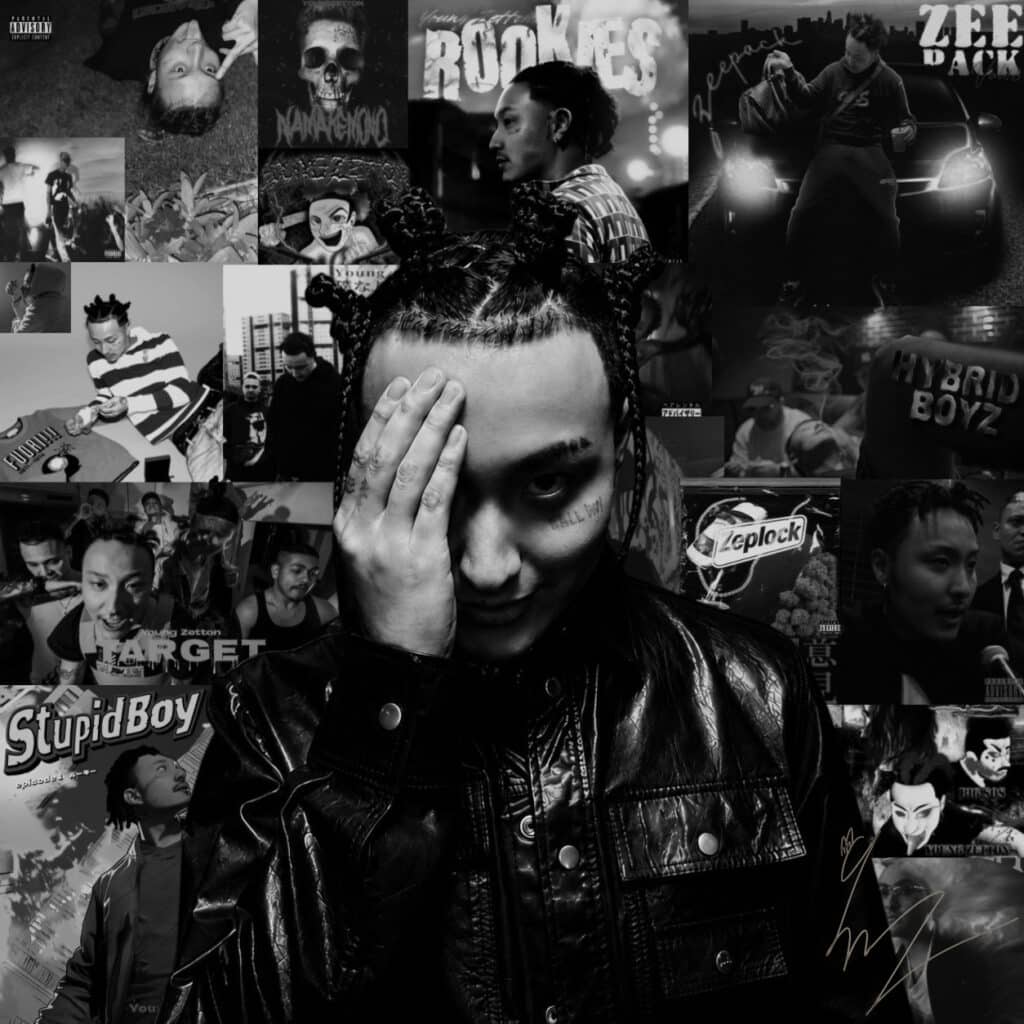
Afterward, the comments beneath the music video for “あの日に戻りたくねぇ,” released Friday, July 3, filled with messages from listeners lamenting his retirement.

As a listener, I felt the same way. Why release a final album now? How did it take shape? What comes next? The questions only kept multiplying.
What words lie beyond the point where that bookmark is pulled away? To find out, I sat down with him once again, joined by YTG Sam.
Interviewing Young zetton Just After the Album’s Release
Tracing his journey and the curtain call of LAST ALBUM: inside the mind of hip-hop’s cosmic dinosaur
Lucie: I was really looking forward to hearing you talk about your final album, LAST ALBUM.
To start, could you introduce yourself again?
zetton: I’m Young zetton, based in Kyoto. Thanks for having me.
Lucie: I’ve always wondered: where did the name Young zetton come from?
When I hear “Zetton,” Ultraman is the only thing that comes to mind.
zetton: People say that a lot. [Laughs]
At first, the people around me called me “Young Z.” Later, a friend came up with the name Young zetton for me. That’s roughly how it happened.
Lucie: I see. Why were they calling you “Young Z” in the first place?
zetton: Honestly, I’m not really sure. People just started calling me that.
Lucie: So it wasn’t related to your real name?
Sam: There’s also a character called Zetton in the manga Crows. It wasn’t from that?
zetton: Yeah, that character was in it. But no, that wasn’t it. I just liked the name.
A Childhood Filled With Love—and Finding Rap
Lucie: Your songs often touch on some pretty hard, street-oriented experiences.
One lyric that stayed with me was, “My grandfather was a loan shark.” I couldn’t imagine what kind of world you had seen.
Could you tell us what your childhood was like?
zetton: My home life wasn’t especially terrible or anything when I was a kid.
Well, my parents weren’t at home, and I was left in my grandmother’s care the whole time, but I lived a normal life. I only learned later that things had actually been difficult. My own memories, though, are of having a happy childhood.
Lucie: Wow. Your grandmother must have raised you so you wouldn’t feel any of that hardship. That’s wonderful.
You’re from Kyoto—what kind of place did you grow up in?
zetton: A place called Kumiyama. There are factories, rice paddies and the Aeon Mall Kumiyama. It’s rural.
Lucie: Listening to your music, I’d somehow imagined it might be a rough area.
zetton: I think Kumiyama is pretty normal. Starting around middle school, you’d see the occasional country delinquent, but it wasn’t especially bad.
Lucie: I see. So how did you encounter hip-hop while growing up there?
zetton: I liked reggae in middle school, but I discovered ANARCHY through “FATE” and Hannya through “何もできねえけど.” From there, I started listening to a lot of hip-hop. I listened to AK-69 too.
Then, about a year after I graduated middle school, I learned about the High School Rap Championship. I dug into tracks by rappers who appeared there, and listened to music by R-Shitei and other artists I saw in MC battles. I liked Kohh—now known as Yuki Chiba—too.
For US music, I guess it was Wiz Khalifa, who a friend introduced me to.
Lucie: That championship really did have a huge impact. Which artists would you say influenced you?
zetton: There are probably a lot.
Early on, Ydizzy had a huge influence on me. Jin Dogg too, I’d say.
How He Began Making Tracks—and Where ALMAR$$$ Stands Today
Lucie: You’ve been releasing work since around 2017 or 2018. I heard that when you first started rapping, you were freestyling.
What made you decide to start recording songs?
zetton: When I was starting out, I watched the High School Rap Championship, so I began going to cyphers.
At one of those cyphers, I met S-MA BISKET—now B1SKET—who had appeared on the show. We became friends and freestyled together.
Then he gradually began focusing on recorded music instead of freestyle and started performing live. Seeing that made me think, “That looks cooler.” That was probably a major factor.
Lucie: So S-MA BISKET had a big influence. Then, around 2017, you began working as part of the crew ALMAR$$$.
What is the current status of ALMAR$$$?
zetton: We never broke up. I just looked around one day and realized I was the only one still active. My impression is that everyone became busy with work or family.
Lucie: What does ALMAR$$$ mean to you now?
zetton: At first, you don’t know how to make a music video or any of that. The people in ALMAR$$$ were senior artists who taught me the whole process, from shooting video to editing.
Lucie: So they were the people who taught you how it all worked.
Something I’d wondered about was a lyric saying you had fallen out with fellow ALMAR$$$ member bigsos. I found myself hoping the two of you had made peace.
zetton: Yeah. I think we’ve made up now. Things aren’t awkward between us.
The Genre Is Still “Young zetton”
Lucie: Looking across the crew’s work and your solo releases since around 2017, I could hear your delivery changing from project to project. That makes the music fascinating to follow.
I heard another change on this album. Was that something you consciously set out to do?
zetton: I think my tastes simply change with each period. My core doesn’t waver, but what I find cool, the music I want to make and what I want to express all change.
Sam: I get that. You have your own current obsessions.
zetton: Exactly. I kept experimenting with how far I could take those ideas and express them without changing who I am. That’s how it happened.
Lucie: So it wasn’t deliberate; what came naturally to you simply became the change. In a previous interview, you said, “The genre is Young zetton.” You’ve truly embodied that.
Something that remains fresh in listeners’ minds is your appearance on RAPSTAR 2023.
I loved that verse enough to memorize it. The way the contrasting images kept stacking up was brilliant. How did appearing on the show affect what you do today?
zetton: I only made it as far as the cypher, but it gave people a chance to discover me. I think that was significant.
Lucie: That show really expands an artist’s visibility. Your song with 999dobby, who appeared in the same season, was incredible too. The music video looked amazing.
On your RAPSTAR track, you rapped, “What you take by force disappears in no time.” It sounded like you were looking back on your past. I felt the same perspective throughout LAST ALBUM.
It feels like you’re reflecting on a more street-oriented period of your life. When did that outlook begin to take shape?
zetton: Well, people probably learn through experience. I think I simply repeated that process over and over.
The Final Album Began With a Suggestion From Homunculu$
Lucie: Let’s turn to LAST ALBUM. How did you decide on its structure?
zetton: At first, I wasn’t planning to make a final album at all. Homu—Homunculu$—and I were simply going to make a collaborative album, and it had far fewer tracks.
Lucie: The finished record is enormous—24 tracks.

zetton: Right. At first it was honestly around 14 tracks.
Lately, I’d started to feel that, as Young zetton, “I’ve done a fair amount.” So I thought I could make this project the final album and bring Young zetton’s story to a clean close.
The number of tracks naturally grew from there. Homu and I discussed what kinds of beats were still missing as we completed it.
Lucie: When I first saw there were 24 tracks, I assumed there had to be several guest features. But there aren’t any. [Laughs] And Homunculu$ produced every song.
You’ve worked with Homunculu$ for a long time, but he’s in Wakayama and you’re in Kyoto. How did you first meet?
zetton: This goes back to what I was saying about the crew. I had a senior named Anubis.
At first, Anu was making music with Homu and a rapper called SAVAGE LION. I heard it, thought, “These beats are crazy,” and that’s how we connected.
Incidentally, SAVAGE LION was the name Lion Melo used when he was a rapper.
Lucie: That’s fascinating. Lion Melo submitted a beat to this year’s RAPSTAR, didn’t he?
zetton: Yes, exactly.
Lucie: I first learned about Homunculu$ when he appeared on TOFU’s Hood Stage on RAPSTAR TANJO in 2020. My impression was that the wider public started recognizing the strength of his beats after that.
Was he already regarded as something of an OG in Wakayama?
zetton: I think I discovered him near the end of 2017. Even then, people around us were already saying, “Homunculu$’s beats are insane.”
Lucie: So he had been making a name for himself in Wakayama for years. How did you arrive at the decision to work one-on-one?
zetton: At first, I wasn’t planning to have him produce the entire project. I only wanted to get a few beats and make several songs.
Then Homu told me, “If we’re doing it, I want to produce the whole thing. That will let me show what I do best properly.”
MIKADO and Homu’s album had just come out, so his case was incredibly convincing. I understood what an honor and a luxury the offer was, and I was grateful. I told him, “Absolutely—please do it.”
Lucie: HOMUNCULUS really was a classic. That alone made the argument completely convincing. [Laughs]
The “Day” in “あの日に戻りたくねぇ”—and a Statement of Resistance
Lucie: Let’s get into the album itself.
Before I knew the album was coming, the music video for “あの日に戻りたくねぇ” happened to appear on my YouTube feed. I thought, “This is incredible,” and then I received the interview request.
It gave me that growing excitement of thinking, “A movie is about to begin.” When the wings suddenly burst out on the line “I’ll show you my wings,” I got chills. I wanted to hear even more over that beat.
What I wondered, though, was which “day” the title “あの日に戻りたくねぇ” refers to.
zetton: It isn’t one specific calendar date. It refers to several different days that come to mind when I look back on my life.
Times when I wasn’t rapping and couldn’t get my life moving in the right direction, or when I got arrested—that kind of thing. I used the phrase “that day” to shine a light on all of those days.
Lucie: I see. The phrase “that day” appears in some of your other lyrics too.
There’s a line like “that day when I performed as the opening act.” I wondered whether it referred to that period as well.
zetton: It does. Those days are what made the present possible, so the title points to them too.
Lucie: So it encompasses all of those frustrating periods. That makes sense.
The album begins with “あの日に戻りたくねぇ,” followed by “気をつけろ” and “REAL RICH.” Just when I’d settled into thinking how good it all sounded, the incredibly sharp “陰謀論” arrives. Its social satire is unmistakable.


Around last year’s protests calling for the Ministry of Finance to be dismantled, you released “僕なりの意見.” It felt like a dramatic shift from the impression you gave on RAPSTAR. At one point I wondered whether you were becoming a socially conscious rapper.
When did you begin to feel that anger or awareness about social issues?
zetton: This goes back to middle school again.
Reggae was popular then, and reggae artists would sometimes express their views about the country in their songs. It is rebel music, after all—music of resistance.
As I researched what they were saying, I began to learn that this country doesn’t always operate as it should. I started with simple things: that television does not necessarily present accurate information, or that police can do bad things behind the scenes.
In Black culture, including hip-hop, plenty of rappers speak about society. I thought that if music could move the community or country where we live even slightly in a better direction, that would be a valid form of hip-hop.
That may have been what started it.
Lucie: I agree. I think that’s right.
When “僕なりの意見” came out, public discussion was so dominated by the protests that it would hardly be an exaggeration to say they were all anyone was talking about. By addressing the issue in a song, you must have encouraged some listeners to think more critically about it.
But having that awareness in middle school suggests you were a remarkably thoughtful student.
zetton: I don’t know about that. [Laughs] Well, it was more like this.
In middle school, it wasn’t that I had a powerful sense of political awareness. It was vague. As I gradually became more knowledgeable, I began to understand it better.
Lucie: I see. My impression is that you don’t hesitate to say, “That isn’t right,” not only about society but about the scene itself.
How do you feel about the scene today?
zetton: Hmm. Looking back now, when I spoke that way, honestly, I think I was being a little immature.
People are free to do what they want, and maybe I didn’t need to say anything. I’m not a complete or perfect person either, and sometimes I do uncool things. These days, I’m fine if people see me that way too.
Lucie: Wow. Somehow…
I think many listeners have an intense image of you. That comes from the feel of your older music—for example, the Homunculu$-produced “奇襲,” a collaboration with Jin Dogg and bigsos, where you were shouting with incredible force.
Talking with you today, though, I can tell you’re actually introspective and look at things calmly.
zetton: Still, sometimes the bad side of me comes out and I think, “Maybe I’ll take a little shot at them on my Story.” I always regret it after I say something.
So now, I don’t really feel anything about it. That might sound strange after I was the one who said those things.
Lucie: But—this is only my personal opinion.
I think a lot of listeners hear your views and agree that you’re right. I’m one of them. Some people do things that are difficult to endorse wholeheartedly while wondering whether they’re really right in hip-hop terms.
zetton: That’s true. People have told me, “I’m glad you said it.”
But, for example, someone who really lives that life might hear my music and think, “What is this mere rapper talking about?” I couldn’t say anything back to that. Nor could I say anything to people in America who are really caught up in gun violence.
So I think I’m beginning to understand that those aren’t the standards by which hip-hop should be measured. I don’t want to behave immaturely.
Lucie: You have an extraordinary ability to step back and see the bigger picture. That perspective is admirable.
Annoying Incidents and Adults Obsessed With Money
Lucie: Your storytelling shines especially brightly on “Stupid Boy.”

The scenes came to life so clearly that I wondered how a story could flow into the listener’s mind so effortlessly. I assume it was drawn from real experience.
There’s a lyric that goes, “Sometimes they tag me—annoying, I don’t even sell *****.” What happened there?
zetton: It’s exactly what it sounds like. An account with a completely black profile icon would tag me in a photo of “that kind of thing,” then make up a name like “something Kush” and post it.
Sometimes I saw the posts myself; other times, fans told me about them in DMs. For a while, it happened pretty often.
Sam: That’s unbelievably irritating. [Laughs]
zetton: Seriously. [Laughs]
Lucie: Another lyric caught my attention: “Talked to a senior’s girl and got my head shaved / They laughed—it was honestly like a manga.” Things like that really happen?
zetton: They do. I really did get my head shaved just for talking to her.
By “talking,” I mean I only said something like, “Let’s hang out sometime.” It turned out she happened to be his absolute favorite.
Lucie: His favorite—and that gets your head shaved? I would hate that world. What a headache. [Laughs]
Then there’s “ニャース” (“Nyarth”). The hook is impossible to get out of your head. Whenever I hear “Nyarth,” I immediately think of its coin—and of money.
Another line struck me as a punchline: “They don’t love music / They love the numbers that come afterward.” Do people like that really exist?
zetton: I’ve seen plenty of them. I can never name names, though.
While we were making that song, Homu and I were talking. Out of nowhere, he revealed some behind-the-scenes story about a famous producer and rapper. I was like, “That’s wild.” [Laughs] I didn’t even know who they were until he told me.
The beat he was making as we talked was the beat for “ニャース.” While I was wondering what to rap about, Homu just said, “Nyarth,” and walked away.
So I thought, “All right, it’s Nyarth.” The song isn’t aimed at any one person in particular. I’d felt that adults like that exist in every industry, so I wrote it just as I saw it.
Lucie: So those stingy people really are everywhere.
The hook stays with you and makes you want to say “Nyarth.” I can imagine everyone singing this one at your shows.
A Self-Titled Track and the State of Kyoto’s Scene
Lucie: Then, at precisely the right moment, comes the self-titled “Young zetton.”
Giving a song your own name made me think, “He’s fully committed—maybe he intends to use every last part of himself.”
zetton: That may be true. By the time I made “Young zetton,” I had already decided this would be the final album. I thought this was my only chance to include a self-titled track.
I added it right at the end of the process, when we had finished as far as track 19 or so and were already deep into the back end of the album.
Lucie: I can hear your resolve on “京都砂漠” as well.

I heard a determination to expand Kyoto’s scene. And because the phrase “京都砂漠” contrasts with “東京砂漠,” it also sounded like a declaration of war against Tokyo’s scene.
zetton: Right. But the truth is, I didn’t even know “東京砂漠.” [Laughs]
Lucie: You made it without knowing? Seriously? [Laughs] How do you see Kyoto’s current scene?
zetton: There are plenty of clubs, and quite a few rappers from other regions come to perform, so there’s definitely activity.
Musically, I think it’s about average. It doesn’t feel far behind, but it doesn’t feel far ahead either. To me, it’s a perfectly ordinary scene.
A lot of younger rappers have emerged recently, but I really want to build more momentum than we have now. Honestly, it still isn’t nearly enough.
Lucie: I see. When people think of Kyoto, ANARCHY is still the first image that comes to mind. It feels as though there could be a lineage following his path.
zetton: Right. On the other hand, ANARCHY may be the only person from here you can truly call a legend.
Lucie: Your name is well known too. I imagine you’ve met artists or had moments when you could hear your own influence in someone. Has that happened?
zetton: It has. Quite a few younger artists have told me things like, “I was listening to your songs back then.” I thought hardly anyone knew me, so it makes me happy to learn that some of them had been listening from a surprisingly early stage.
Facing a Cold, Dark Past—and the End of Young zetton
Lucie: We’re nearing the end, so let’s talk about “冷たい朝.” It felt as if you were reopening old wounds yourself. And when I hear the word “cold,” it brings “that kind of thing” to mind.
As we discussed earlier, there is always “that day” in the background. I wondered whether you were transforming the negativity tied to that period. How did you find your way out of it?
zetton: Probably because the central part of me—the part that loves music and creating things—never wavered.
Even when I was down or doing things I shouldn’t have been doing, somewhere inside I kept thinking, “No, this isn’t what I truly want.” I kept doing what I needed to do, and eventually I found I had made it out.
I guess it happened when I realized what I truly needed.
Lucie: That’s wonderful. Your commitment to music was what carried you through.
Then there is the final track, “B型で繊細.” That title is excellent too.
On the song, you sing, “Who made you suffer?” It can sound as though you’re speaking to someone else, but it can also sound as though you’re speaking to yourself. That line felt incredibly powerful.
zetton: Different people will receive it in different ways, and I’m happy for listeners to interpret it however they do.
I imagined speaking to a dejected version of myself in the mirror. I wanted a scene that felt as though I were addressing myself and another person at the same time. That was the idea.
Lucie: I see. That makes it incredibly clear. With “B型で繊細,” LAST ALBUM closes while leaving a sense of hope.
I’m still thinking, “This can’t really be the last one,” and wishing it would not end. Would it be right to understand this as the last album under the name Young zetton?
zetton: That’s right. I had been thinking it was about time to work under a name connected to my real name, so yes, that is a fair way to understand it.
Lucie: So that’s what it means.
Do you have a message for everyone who has listened to Young zetton’s music over the years?
zetton: Thank you so much for listening.
Closing Note: The Metamorphosis of “Young zetton”
And so it ends. The story of Young zetton truly draws to a close.
Having shed the shell of the cosmic dinosaur and finally become human, will he continue forward as a rapper, or make his name on another path? We cannot know what shape Episode II of his story will take.
Yet we have witnessed great wings emerge from the back of the “caterpillar” he once was. Even as the credits rolled, a curious sense of hope remained. Who could resist anticipating the post-credits scene that may be waiting?
We will be waiting for that day.
LAST ALBUM by Young zetton

https://music.apple.com/jp/album/last-album/6786137263
https://open.spotify.com/intl-ja/album/4usA0Y79d3QnjbUboQVjUm?si=RZaMAyjYTNu6ZDZxV7U_0w
Rapper Young zetton’s final project, LAST ALBUM.
Wakayama producer Homunculu$ produced all 24 tracks. Over beats built from a deep understanding of Young zetton’s strengths, the rapper candidly lays out a wide range of subjects: his honest feelings, inner conflicts and view of society.
The subjects are not the album’s only source of variety. From emotional flows to forceful deliveries, it condenses every skill Young zetton has developed. Despite its 24-track scale, each song reveals a different side of him.
In other words, LAST ALBUM contains the full journey, outlook and technique of the rapper known as Young zetton.
Young zetton: Official Links
- Instagram (@youngzetton)
- X (@Young7zetton)
- YouTube (Young zetton Official)
- Apple Music
- Listen to LAST ALBUM on Spotify
Homunculu$
Interview and Credits
Interview and text: Lucie (HIPHOPCs)
Also present: YTG Sam (HIPHOPCs) / Instagram (@ytg_sam)
Publication: HIPHOPCs / Instagram (@hiphopnewscs.jp) / X (@hiphop_cs)
The images in this article are used with permission from Young zetton’s team. Unauthorized reproduction is prohibited.