Doll-E Girl Interview: Chicana Rap, Japan and Still Being in Her Prime

English translation of HIPHOPCs’ published Japanese-language interview. This edition is not a verbatim transcript of the original English conversation. Originally published in Japanese on September 7, 2026. Ages, plans and references to the present reflect the original interview, not a new interview conducted for this translation. The introduction, afterword and repeated phrasing have been condensed for this English edition.
Doll-E Girl has spent more than twenty years in Chicano rap, making a place for herself in a male-dominated scene as both a rapper and a label owner. In this interview, she recalls writing two pages for her first verse, playing a burned CD for her father and discovering that she did not own music she had written.
She also talks about raising her son, running Set Up Shop Records and making music beyond the “Chicana rapper” label. When the Japanese interview was published on September 7, 2026, she was looking ahead to her return to Japan for Feliz Fiesta. More than twenty years in, she still felt she was in her prime.

SEI: First, could you introduce yourself to Japan’s hip-hop fans?
Doll-E: I’m Doll-E Girl. I’m from East LA, born and raised on the East Side of Los Angeles, in Lincoln Heights. I’ve lived here my whole life.
2Pac said it, right? “To Live and Die in L.A.” Well, I don’t know if I’ll die in LA. [Laughs] But I’m happy here.
SEI: I understand. You’re going to Japan in September, right?
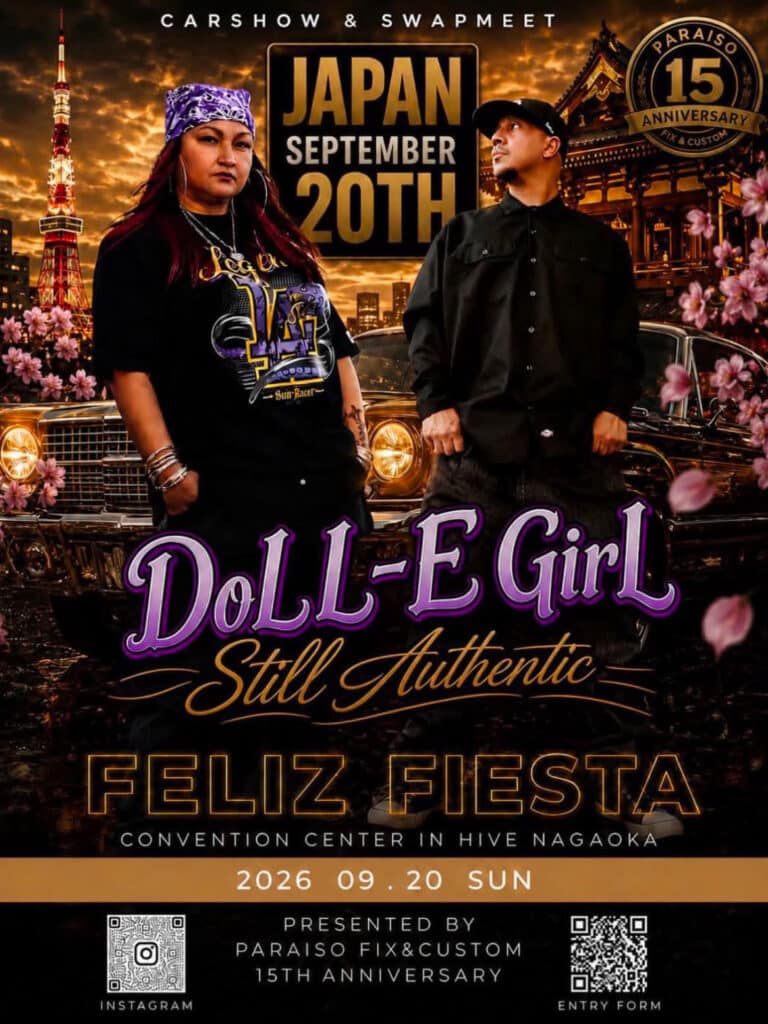
Doll-E: That’s right. Around September 20, I think. There’s a big event, Feliz Fiesta, and that’s what I’m going to Japan for.
SEI: How did you become involved in Feliz Fiesta and come to perform in Japan this time?
Doll-E: I’m really close with DJ Paco. I don’t know all the details, but Paco works with the event people, and I think he’s involved with the organization behind it. [Editor’s note: DJ Paco handles booking for the event.]
Japan, Lowriders and Chicano Culture
SEI: This is a lowrider event. What connections have you had with Japan and its lowrider and Chicano scenes?
Doll-E: It’s amazing. Let me go back to the first time I went to Japan. I genuinely had no idea what was waiting for me. I never expected to see what I saw.
It was around the time of my first album. I was so focused on life here and our own lifestyle that I hadn’t even considered that this culture might exist elsewhere in the world.
When I landed in Japan and saw everyone who had come to pick me up, I was like—
“Oh my God! Look at this!” Everybody was dressed like the homies.
“What is this? This is so cool! They look like homies!”
At first, I just thought they were supporting what we did by buying and wearing other rappers’ T-shirts. I didn’t know where the shirts came from. Even that alone seemed amazing.
But walking around Japan, I found stores selling those clothes as a regular thing. That surprised me all over again.
SEI: That connects to my next question. Lowrider culture began thousands of miles away, yet communities in Japan have embraced it very deeply. What does it feel like to see your culture respected there?
Doll-E: Listen to this. We had a show that night, and people were pulling up to the venue in lowriders.
The young women were dressed like homegirls: eyeliner, hoops, chola-style bandanas. I was just—
“Yo! It’s like I’m with my own people!” “My people! Amazing!” [Laughs]
Then we went into the clubs. I think we went to two or three, and every one had a Mexican flag. It melted my heart.
“I love these people. They love our culture this much.”
It was genuinely beautiful. Then I looked at the lowriders and thought—
“Oh my gosh, they look like they came straight out of the neighborhood in East LA!” “They have lowriders in Japan, too!”
What I loved about that first visit was that it was all still developing.
SEI: Developing?
Doll-E: Yeah. The cars weren’t set up to hop really hard yet. They could mostly just move up and down.
SEI: I see.
Doll-E: Exactly. But even then I thought, “Damn, this is so cool!” It felt great.
Then I went back to Japan a few years later, and everybody had upgraded! Oh my God. Now they were moving side to side, too.
I was like, “Wait, you’ve taken this so much further!” [Laughs]
SEI: Was there anything you found surprisingly authentic, or something that felt uniquely Japanese?
Doll-E: I’ll never forget this. Two guys came to a show. One had a red flannel, a red bandana and red pants: red from head to toe.
SEI: Wow. Like B…?
Doll-E: Right. [Laughs] And his friend had a blue bandana.
SEI: Oh my God. [Laughs]
Doll-E: But they came together! I said, “Wait. You two know each other?” I had the interpreter ask, and they said, “Yeah, we’re best friends.” So I told them, “Just so you know, if you show up together in LA dressed like that, you could get into serious trouble.” [Laughs]
SEI: Yeah, yeah, yeah. [Laughs]
Doll-E: I explained the background—South Side, North Side and all that. They were both laughing so hard. Then I understood, too: “Here in Japan, they dress like this because they love our culture and want to represent it.” Maybe they don’t understand all the politics behind it. But that’s not the point for them. They’re doing it to support the music and the movement.
That’s what I fell in love with.
The Line Between Respect and Imitation
SEI: When a culture travels to another country, there can be a fine line between appreciation—loving it with respect—and imitation. What does respectfully representing Chicano or Latino culture mean to you?
Doll-E: I love, love, love, love that question! Let me tell you why. In California and other states right now, this is a really sensitive issue.
Imitation and representation are different. Some people mean it, and some just want the look. The kids who genuinely dress that way probably have parents from that era or some connection to that background. That’s why the kids dress that way now. I respect it and understand it: they’re also taking pride in where their parents came from.
But there are also people here wearing Cortezes, baggy pants and a T-shirt whose families aren’t from that world and who know nothing about the culture. When I see that, I think—
“If you’re going to dress that way, you’d better be prepared.” Someone older might read that look as intimidation or a threat.
SEI: Right.
Doll-E: Exactly. Here, if you dress like a Southsider, a Chicano or a Chicana, you have to be ready to back it up when someone asks, “Why are you dressed like that?” If you can’t, you have to take responsibility for the consequences.
But Japan is different.
When I see people dressed that way in Japan, I don’t see imitation. I see pride in what they support. They genuinely love our culture. They’ve done their homework. They’re trying to understand where it comes from and why the style exists.
SEI: That’s exactly what I wanted to ask. Thank you.

What Is Chicano Rap?
SEI: For Japanese listeners less familiar with it, how would you explain Chicano rap? Is it a genre, a culture, an identity—or all of those?
Doll-E: It connects to what we were saying. Chicano rap originally came out of gangsters’ music. Back then, the people making it were basically gang members.
SEI: I see.
Doll-E: Gang members rapped about their lives: street life, breaking into cars, getting arrested, fighting. Around the time I came out, it started branching off a little. I was one of the early Chicana rappers. I rapped about my own life—being active in the streets and my neighborhood. Before me there were women like Teardrop and JV. People include them as Chicano or Chicana rappers, but to me they were Latin female rappers, because Teardrop and JV weren’t rapping about gangs or gang life.
SEI: So they were representing Latin music and culture as Latinas.
Doll-E: Exactly. They represented the homegirls, too, but in a softer, nicer way. Then I came out, and there were Lady Sample, Miss Pink, Miss Sancho and B Wicked. Those were some of the early women. We were all active, so we talked directly about that life.
I think the men had influenced us a lot before that. Hearing men who were actually gang members rapping about their lives, I thought, “I get this. This is my life. I love it.”
One of my biggest mentors was Slow Pain from Old Town Mafia. He was a genuinely big figure. He rapped about that life, too, and I’d think, “I relate to this.” So I thought, “Then I’ve got to represent the homegirls.” I stepped out for them and said my piece. Then doors started opening one after another.
And it reached Japan, and people there started listening.
Why did Japan get into it? For one thing, I think they liked how we dressed. [Laughs]
SEI: Definitely. [Laughs]
Doll-E: And they liked the beats. Back then, people in Japan didn’t understand what we were saying, right?
SEI: Probably not. [Laughs]
Doll-E: Right? [Laughs] But through the videos, our clothes and YouTube, I think they gradually came to love it.
Chicano Rap and West Coast Hip-Hop
SEI: How do you see the relationship between Chicano rap and West Coast hip-hop? What connects them, and what makes Chicano rap distinct?
Doll-E: Speaking for myself, I’ve always been a huge Bone Thugs-N-Harmony fan.
SEI: Oh my God! I love your song with Bone Thugs. I was going to ask about that, too. [Laughs]
Doll-E: There we go. [Laughs] Their style was a little different, but I really related to it. When I was young, I was hustling in the streets—wheeling and dealing and stealing. I was doing all kinds of things. [Laughs]
They rapped about that and about smoking, so I thought, “Here’s more music I understand!” Plus I was like, “They sound good. They’re smoking? Then I’m smoking, too!” [Laughs] Especially when Eazy-E worked with them, it felt like everything connected.
But when I entered the industry, it had never once occurred to me that I would connect and work with that side.
SEI: With Bone Thugs?
Doll-E: Right. I was new and knew nothing about the industry. I just wanted to make music with the people in my circle. Eventually, though, I started thinking, “Why not reach out to people over there and ask if they want to make music together?”
I was lucky enough to meet Frank Nitti. He connected me with Bone Thugs. I was a little better off financially then than I am now. [Laughs] So I could afford to approach Layzie Bone and Bizzy Bone.
SEI: Wow. Layzie and Bizzy?
Doll-E: Yes! When they agreed to get on the track, I nearly lost my mind. [Laughs] That was “Better Dayz.” At first I thought they’d just send their verses.
But no. They arranged for us to be in the studio together!
SEI: Oh my God. That’s amazing.
Doll-E: That’s when I realized, “I can cross over and connect like this.” It was incredible.
There’s support from West Coast hip-hop, too. They respect us, and we respect them. Over time, there’s been more of that crossing over and connecting, which is great. I’ve also worked with Goldie Loc from Tha Eastsidaz.
SEI: Really? Amazing!
Doll-E: We have a song. I also have one with Roscoe, Kurupt’s younger brother from the Dogg Pound circle. Those things gradually started happening. It’s a blessing for me, because those connections bring more listeners and expand our world.

Her Most Memorable Collaboration
SEI: I was going to ask later, but you’ve featured and collaborated with so many artists. You’ve already named a few. Which experience was the most memorable?
Doll-E: Oh, this one. This one! [Laughs]
SEI: Bone Thugs, of course. [Laughs] I really love that song. I was listening to it all the way here today.
The “Chicana Rapper” Box
SEI: Going back to Chicano rap and identity, what do people outside the culture misunderstand about it?
Doll-E: Especially now, they put us in a box too much. I hate that. Speaking for myself, yes, I came from Chicana rap. I’m Chicana; those are my roots. But I’ve grown as I’ve gotten older, and my music has changed. I’m still from the neighborhood, but I’m no longer doing the things I used to do there. You know?
SEI: Absolutely.
Doll-E: I don’t break into cars or steal anymore. That was when I was young. I don’t do it now. So if I grow, my music has to change, too. I don’t lie in my music. I only talk about what’s real. Now I’m hustling and grinding and still a badass, doing what I need to do to stay on top.
As you get older, you also realize there are lots of young women watching you. They like my style and know I’ve been through things. But I don’t want to tell them, “Hey, homegirl, I did this, so you should be active in the streets, too.” No. I want to say, “I’ve been through some shit and seen the worst of it. But I came through all of it.”
My music keeps evolving, but people still put me in the “Chicana rapper” box. Yes, I’m Chicana and I make Chicana rap. But I also make other rap, R&B, songs in Spanish, slow songs and fast songs.
You want me to only rap? No, I’m doing everything. [Laughs] I love music itself. Some rappers only rap, and some singers only sing.
I’m different. I do it all. I listen to everything because I love music.
I want people to understand: you can remember the box I came out of, but I can do things outside that box, too.
Take “Trust No Bitch.” That song won’t die.
SEI: I love it. I listened to that on the way here, too.
Doll-E: Right? It still gets played. I love it. That’s Chicano rap, and I wrote it directly from what I was going through then. I still perform it sometimes.

One Song for Japanese Fans
SEI: If you could recommend just one Chicano rap song to Japanese hip-hop fans, what would it be? Yours or someone else’s.
Doll-E: My music. Listen to me. You don’t need to listen to anybody else! [Laughs]
SEI: [Laughs] Understood. I really like the new song you released in May, too.
Doll-E: “Maladrinas.”
SEI: Yes, “Maladrinas”! I can’t get that hook out of my head.
Doll-E: Yeah. Shout-out to Snoop Dogg for that hook.
SEI: You rap in Spanish, too, right?
Doll-E: Exactly. Like I said, I’m opening my mind in all kinds of directions. My music isn’t just one thing. I love listening to different things; it keeps me humble. I listen to a lot of R&B because it relaxes me.
SEI: Is that why you sometimes sing?
Doll-E: Exactly! Tell everybody: I listen to R&B all day. What I love about my music is that there’s a song for everybody.
Having a bad day? I’ve got a song for that.
Getting divorced? I’ve got one for that.
Getting married? That, too.
Going out on the streets with your homegirls? Of course.
I’ve written over a hundred singles, for all kinds of situations. I think anyone can find one that makes them say, “That’s my song.”
Going forward, I want to make a little more music that grown people can relate to.
SEI: For more mature listeners?
Doll-E: Yes. Interestingly, a lot of my listeners are around 25 to 35. I hope my music can have a positive effect on them, too.
SEI: You must have lots of women among your fans.
Doll-E: So many. I have a huge number of female fans, and I love that. When I make music, I know who I’m talking to.

Surviving as a Woman in a Male-Dominated Scene
SEI: You’ve been making music for over twenty years. Chicano rap was probably even more male-dominated when you started. What was it like to make a place for yourself as a woman?
Doll-E: There was a moment when I knew I’d made space for myself: when the men started asking me questions. That’s when I thought, “I’ve got this.”
I’ll never forget it. I think I’d been in the industry about three years. I came out around 2003 or 2004, and by about 2006, guys were asking me, “How did you do this? How did you do that?”
I was like, “Why are these men asking me?” [Laughs] Then I realized, “Oh, I know my shit. I’m actually making money.” That’s when it became clear.
But it was hard. For a while, it really felt like I was the only woman. Still, I was just doing what I loved. I’ve always been myself. I’ve never thought I was above anyone. I’m not someone who sits backstage acting important until she’s called. I’ve always been outside with everybody.
Always.
Because having this position at all is something to be genuinely grateful for.
How Doll-E Girl Started Rapping
SEI: Did you rap as a child?
Doll-E: No. Rapping wasn’t even my idea.
SEI: Really? Were you more into singing?
Doll-E: Yes. My late father loved electronics and video. Whenever something new came out, he’d buy it: camcorders, cameras, lights, everything. From when I was about three, he’d teach me songs and film me once I’d learned them. I’d sing; he’d record. It was always like that. So singing and being in front of a camera became natural. He entered me in talent shows, too.
SEI: When did rap come into it?
Doll-E: I was in a car club called Night Crowd in Whittier. Two members rapped and made their own songs. One day they had an empty verse and said, “Why don’t you get on this?”
I said, “What the hell is a verse? What are you talking about?” [Laughs] They told me they’d made a song and wanted me on it, but I was like, “What am I supposed to do?”
They said to write something between where one part ended and the next began. I was an only child, and I’d always written a lot of poems and diaries. I’d kept diaries since about fourth grade. I had so many notebooks.
So I said, “OK, let’s try it.” I listened to their song and started writing—and I wrote two pages. [Laughs] A verse is only eight or sixteen bars!
SEI: Exactly. That’s all. [Laughs]
Doll-E: Two pages! [Laughs] So I could write fast. But when I listened to the recording later—I still have it—I was so off! [Laughs] It was terrible. I wasn’t on the beat at all. I was all over the place. Complete chaos.
SEI: How old were you?
Doll-E: Around 2002, I think. Probably my early twenties, not my teens. I hadn’t even been trying to become a rapper. I just stumbled into rapping. [Laughs]
SEI: That’s funny!
Doll-E: We released the song. I was able to play it for my dad before he passed away, and he was so happy.
The funny thing is, I was rapping in English and saying the F-word constantly. [Laughs] It wasn’t really something you’d play for your father. But I thought, “Let me show him.”
Even though it was just a burned CD, hearing his daughter’s voice on it made him so excited. If he were still alive and well, he’d absolutely be my manager. He supported me everywhere. Everywhere. I still carry that with me.
The song got into people’s hands, and Slow Pain heard it. Other people told me, “It sounds good, and your voice is good, but you need to keep working on yourself.” I thought, “Cool.”
The person who properly taught me how to write bars and everything was Tony G, an old-school rap and hip-hop godfather. He’s made so much music and so many hits for Latin artists. I was genuinely happy to learn from him.
When I recorded the first song for my first album with him, I went into the booth and was getting ready. He said, “Relax and have fun. And don’t worry about Eazy-E, Ice Cube and Dr. Dre having recorded on that same microphone.” [Laughs] I was like, “What!? No way, bro!”
SEI: That’s pressure. [Laughs]
Doll-E: Yes! “F—! Let me out for a second! I’m starting over!” [Laughs] But it was amazing.
Women in Hip-Hop Today
SEI: Comparing women in hip-hop now with when you started, what has changed most? What still needs to change?
Doll-E: OK, listen. Oh God. [Laughs] This is just my opinion. Everybody has one. I’m speaking from what I’ve seen in the game and what I represent as a woman. Women in hip-hop have changed dramatically. I mean the younger women under thirty, not the OGs or women in their mid-thirties.
There are so many talented ones. They sound good, their voices are good, and they’re doing their thing.
But the message and the presentation are something else.
Of course they’re beautiful. I like the clothes; they look great. But as a woman in this industry putting yourself out there, I wonder whether there could be some limits.
You don’t have to arch your back in every video. You don’t have to be almost naked every time. You don’t have to show young girls that inhaling nitrous from balloons, drugs, drinking, smoking and doing whatever with men are all cool. Young boys watch that, too. There’s no need to make women look so easy.
Homegirl, make the guys wait a little. [Laughs]
SEI: I understand what you’re saying.
Doll-E: Just a little. [Laughs] I’m not hating. If that’s what someone wants to do, do it. But I know these women can do more than that.
Want to put out a booty song? Fine, do it. But put out another one saying, “Yeah, we can be ratchet, but we can be smart bitches, too.” You know? Show that you’re intelligent, too. That’s my point.
SEI: Yes, I understand completely. I feel the same.
Toughness and Vulnerability
SEI: Did you learn a certain toughness to survive in the industry, or were you always that way?
Doll-E: I’ve always been pretty tough. I’ve never folded, and I’ve always held my ground. Of course I’ve cried. Many times I’ve thought, “Have I failed?” “Maybe I can’t do this.” “I want to give up.” “I want to quit.” I’ve had weak moments. Sometimes I think I’m really depressed, but maybe it isn’t that so much as a mental state of, “Damn, I’m doing too much. I need to slow down.”
Competing in this world full of men is crazy. But I’ll do it. If I can stand on the same level, that’s great. “Come on, bro. I’m doing this. Move!” [Laughs]
But I think the way I grew up definitely matters: raising myself in the streets. That’s a huge part of it, and I’m proud of it. I always tell my son, “I don’t like the road I took, but I’m glad I went through it. Now I can protect you and teach you what to watch out for.”
I don’t know whether he’ll become a rapper or something else. But I want to be a tough mom who can protect him in this world.
What She Would Tell Herself Twenty Years Ago
SEI: Thank you. That was really meaningful. Let’s talk about your career. Your first album was To Know Me Is To Love Me, right?
Doll-E: Yes. In 2005.
SEI: If you could sit down with the Doll-E Girl of that time, what would you tell her?
Doll-E: I’d say, “Some really fucked-up times are coming. But don’t be foolish. Don’t worry too much. Shake it off and move forward.” Want to cry? Go cry in the bathroom. When you come out, have a good hot meal, smile again and start over.
If I could really tell my younger self something, I’d say “It’s going to be OK” as many times as it took.
Don’t let it beat you down. Don’t destroy yourself with stress. You’ll get tougher.
And there will be rewards at the end.
The Many Times She Thought About Quitting
SEI: In these twenty-plus years, have you seriously considered quitting music? What kept you going?
Doll-E: Yes. Honestly, I think I’ve repeatedly wanted to quit ever since I started. I didn’t understand what I was entering. Especially when YouTube came along, I wondered whether I could figure it out. You’re still young in your early twenties, still learning how the world works.
Then there are groupies, men, alcohol, smoking and everything else. It’s different from the streets, but the industry has its own craziness. You especially have to be careful entering it as a woman. There are plenty of powerful men, people you don’t know, gangsters. You don’t know where everyone comes from.
Expecting the young me to check, “Who’s this? Where’s that person from? What’s this about?” every time was impossible.
Sometimes I also thought, “I’m making music, but nothing’s happening. What am I doing it for?” But I can tell you one thing: every time I’ve thought about quitting, a door has opened.
SEI: Really?
Doll-E: Every time. Every time. I’ll think, “I don’t want to do this anymore. I give up. I’m done. I just want to fix cars and be with my family.” Then—
“Hey, darling, you’ve got a show!”
Boom! Money.
Or I think, “Nobody will record me. Nobody’s doing anything. I’m quitting.” Then—
“Hey, darling, you’ve got two or three feature offers.”
Every time.
SEI: That sounds like a sign.
Doll-E: Yes. A sign that there’s a reason I’m still here.
But once I stay, I start doubting myself again: “Am I just excited and wanting it to be a sign? Do I just love music too much to quit?”
My mother always says, “Everything happens for a reason.” And I think, “What!? That’s a pretty ridiculous reason!” [Laughs]
But if that’s the reason, then I’ve got to go. Let’s go.
I carry a lot mentally. Sometimes I feel depressed. But I’m working my way through it.
I push forward. I think I’m still kicking ass.
And right now—we’ll talk more about it later—I’m starting to bloom. The petals are opening, and all kinds of things are beginning to happen.
What Success Means
SEI: That’s beautiful. How has your definition of success changed over more than twenty years?
Doll-E: Dramatically. Honestly, if I’d focused only on Doll-E for those twenty years, I think I could be much bigger now. But I never focused only on myself. That’s why I’m still not where I really want to be. That was my mistake.
But whenever I drop a song, people come back. The support is still there. There was a two-year period when I put out no music at all. “Maladrinas” came out in May, and the single before it was more than two years earlier.
The moment I released “Maladrinas,” people came back saying, “Oh, Doll-E’s still doing it!” The calls came in. The love is still there.
So again I think, “This is what keeps me here.”
Like I said, the petals are opening now. I’m beginning to bloom. I believe the success I’m chasing is still ahead of me.
From CDs to Streaming
SEI: How often do you plan to release new songs?
Doll-E: I actually have songs in Spanish and songs in English.
SEI: Spanish, too?
Doll-E: My goal is probably another three songs by the end of the year.
SEI: The industry has changed dramatically from physical sales to streaming, social media and going viral. What was the hardest shift to get used to? You mentioned giving your father a burned CD.
Doll-E: Yes. I like digital. I think it’s great. But honestly, I wish it hadn’t gone digital quite so quickly! [Laughs] We made so much money when albums were on CD. All the gangsters were making money from CDs. Ten dollars, ten dollars, ten dollars—cash right there. Now it’s digital, and you get paid through streams.
The upside of CDs now is that you can charge twice as much. [Laughs] They’re souvenirs or keepsakes. People get them signed and display them. They don’t actually open and play them; they listen on Spotify or Apple Music.
For some people, CDs are worth more now. I’m like, “Cool, at least I can sell my CD for twenty dollars!” [Laughs] That part’s good. What I miss is the quick cash in hand from the CD era.
What Changed—and What Didn’t
SEI: Comparing Doll-E Girl now with when you started, what has completely changed, and what hasn’t changed at all?
Doll-E: Who I am hasn’t changed. I’ve been me from the beginning. I’ve never thought I was the best or better than someone else. I’ve always kept it a hundred and been genuine. I’ve always been open with people.
What’s changed is simply that I’ve grown up. I’m no longer active in the streets. That’s the past. It was fun, but I’m not doing it anymore. [Laughs]
But neither music nor everything I’ve been through turned me into someone I’m not. I’m glad about that. Going overseas and to other states has all been amazing.
I believe music saved me. Before music, the world I knew was about a ten-mile radius. Just the neighborhood.
Once I started music, there were new restaurants, new places and new faces. I could go out of state.
When I first started, I was on probation. I had a show in Albuquerque but couldn’t go.
SEI: You were on probation? Wow.
Doll-E: For a year. My label manager at the time came to court and asked the judge, “Can I take her out of state for two days for work?” So every out-of-state show meant going to court.
Eventually the judge said, “That’s enough. You haven’t caused any trouble. Go make your music,” and ended my probation. I was like, “Yes! Let’s go!” [Laughs]
Her Own Company: Set Up Shop Records
SEI: Tell us about your record company. Alongside being an artist, you run Set Up Shop Records, right?
Doll-E: Yes.
SEI: How important have independence and ownership been throughout your career?
Doll-E: It’s been a great experience because it showed me a side of myself I didn’t know: “I can do this, too.”
I started Set Up Shop Records in 2006, twenty years ago. I think we had five or six artists initially. I ran it using what I’d learned in the industry.
It was pretty good—not bad. We had some solid artists.
Then in 2023, I was talking with my manager, Ed. He said, “You keep saying you want to run a record company. I don’t think you’re ready yet, but if you still want to, why not try?” I said, “All right, cool.”
I’m glad Ed was on the team. He really understands contracts. He brought a level of professionalism I hadn’t had before. That’s one part of it.
With the artists we have now, I made the label more independent in how it operates. Everyone makes their own music, promotes themselves and handles their own work while representing the company and me. That’s how we work.
Then we thought, “Let’s try a tour.” Last year we did the Alpha Queen tour: Utah, New Mexico and about six stops altogether. We went around, and it was a really good tour.
It was the first time I’d done it myself, and I thought, “Shouldn’t I be doing more of this?” [Laughs] Some of the artists are still handling things well themselves.
SEI: That’s great!
Doll-E: We’ve all calmed down compared with before, so when we party, it’s just a normal party. We can’t stay up all night anymore. [Laughs]
But I keep saying, “When I get to Japan, I’m forgetting all of that!” Paco knows. Y’all better be ready. [Laughs]
I’m really focused now. I have been since 2023. The label is doing well and growing. More people know us, and we’re expanding.
I’ve learned how to focus on myself and on the label. It’s crazy and difficult. But without focus, you can’t do anything.
Ownership and Young Artists
SEI: Do artists today understand enough about hip-hop’s business side, especially owning their music and brand?
Doll-E: No! Not at all! It’s bad. [Laughs] They absolutely need to know more. Looking at them is like looking at my younger self. I was lucky to have a little guidance when I was young—people telling me what to do and what not to do. Of course, there was still about eighty percent I didn’t know. [Laughs] But I had some guidance.
A lot of kids today aren’t doing their homework at all. This really matters. I learned quite late, too: own your name and your website. Research the writers, publicists and everyone else. Read the contracts. If you don’t understand one, take it to someone who does and have them read it.
There’s so much you need to know, but they don’t know it. Then one day they end up like I did: “What the fuck!? What do you mean I don’t own my own work? That’s my music. I wrote it. It’s my album!”
But you’re told, “No, you don’t own it.” You see?
SEI: That actually happened to you.
Doll-E: Oh, hell yeah. I’m Chicana, and I was a gang member when I came into the industry knowing nothing about it. I was just making music because it was fun.
I didn’t know I needed to register my name. I didn’t know there were ways to own what I wrote. But it’s so important.
For example, someone says, “We’ll pay this much for the song, but we own it,” and people say, “Cool,” and just take the money. No. You have to say you want royalties, too.
That song could be played for the rest of your life. If you have children later, you might be able to leave those royalties to them. Five cents or twenty cents adds up. That’s why it matters. You have to understand it.
SEI: Young artists just starting out: listen carefully to Doll-E Girl. [Laughs]
Still in the Middle of the Story
SEI: Let’s talk about your music and what’s next. Where are you musically right now? You mentioned starting to tour last year. What chapter are you in as an artist?
Doll-E: I think I’m still in the middle of the book. Still in the middle of a chapter.
SEI: Still in the middle?
Doll-E: Yes, about halfway. Even after more than twenty years in the industry, I still feel I’m in my prime. There’s so much I still want to release and do. There are so many sides of me people don’t know yet.
And they’re coming.
SEI: It’s coming. I like that! What can fans expect next?
Doll-E: This is where the petals blossoming comes in. My petals are opening. I’m creating more content and livestreaming more. I’ll travel more, returning to places I haven’t been in a long time. New music, videos, merchandise and production. I’m also working on another business connected to Halloween.
SEI: Completely separate from music?
Doll-E: Yes, a totally separate side business called Haunted Hood Collection. It’ll center on Halloween-type things, but also offer products connected to other holidays. There’s one definite thing I don’t want to talk about until it launches. But I think it’s something for my people.
The biggest thing right now is that Mario and Ruth, a married couple from Hertz Media, offered me the lead role in a film they’re making—and co-ownership, too.
SEI: Wow. So you’ll be acting?
Doll-E: Yes. They also gave me artistic control. I’m so excited. We start filming next Tuesday.
SEI: What kind of film is it? Still a secret?
Doll-E: It’s still confidential. But I want everyone to know it’ll be my first time starring in a film. I’m so excited, because I think it could open more doors, including auditions for other films.
So many things are opening up now. I feel very lucky.
And I just can’t wait to work. [Laughs]
The West Coast and Keeping It Real
SEI: We’re nearing the end. What does the West Coast mean to you?
Doll-E: Hey! California, baby! [Makes a W hand sign]
SEI: [Laughs] I love it. In hip-hop, people often say “keep it real.” After more than twenty years, what does that mean to you in 2026?
Doll-E: Don’t bullshit me. That’s it. Don’t feed me pointless lies. I’m tired of bullshit. Tell the fucking truth. Be real. That’s what keeping it real means to me now. No nonsense. I don’t have time for it anymore.
Before, I could live with, “Yeah, that person’s cool. Will they show up? Maybe. Maybe not.”
But now, no. I don’t have time to wait for that.
What Feliz Fiesta Means to Her
SEI: What would you like people in Japan to remember after seeing your performance at Feliz Fiesta, once you’ve left the stage?
Doll-E: First, they’ll think, “Doll-E’s fun. We want her back!” [Laughs]
Seriously, though, this show means a lot to me. I’ve gotten older, and I’ve watched the music in Japan change. At first it was mostly gangster rap. Now there’s reggaeton and club music. It’s really changed.
I told Paco, “It’s really important that I get back to Japan soon.” I want to bring that music back to life for the OGs. And I want their children to see what that music was like.
SEI: Representing.
Doll-E: Exactly. This year’s show in Japan is for the OGs: the people who were there from my first visit and across my past three visits. I’m dedicating this show to them. That’s why it’s so important.
If I wait another four years, it might not be the same. So now is the time. I want to show them I can still come in and say, “All right, everybody, I’ve brought it back!” That’s why this trip matters so much.
I can’t wait to show Japan to Still Authentic, too. It’ll be his first time, and it’ll blow his mind. I told him, “Bro, when you come back from Japan, you’ll feel different. You’ll wonder why nobody’s being so kind or taking such good care of you.” [Laughs]
People in Japan are genuinely sweet, caring and considerate. I love that.

What She’s Looking Forward to in Japan
SEI: What are you most looking forward to in Japan?
Doll-E: Just seeing everybody.
SEI: And then?
Doll-E: And drinking Asahi. [Laughs] I’m telling you now: have the Asahi ready for Doll-E Girl! But I’m really excited. I’m ready to stay up for five days. I want to have fun and really make this visit count.
This is for the OGs.

A Message to Japanese Fans
SEI: Thank you. Any final message for your fans in Japan?
Doll-E: First, thank you for supporting me all this time. Thank you for welcoming me whenever I return to Japan. Thank you so much for always being there.
And be ready. We’re taking over. [Laughs]
When I get back, it’s Team No Sleep Japan.
SEI: I’m sure there’ll be plenty of Asahi. [Laughs]
Doll-E: Yeah. Have it ready. [Laughs] I’m ready. Everybody, get your sleep before I arrive! [Laughs]
Seriously, thank you, everybody. It’s a real honor to return to Japan once again.
After More Than Twenty Years, Doll-E Girl Is Beginning to Bloom
Throughout the interview, Doll-E Girl returned to the idea that she is not finished. More than twenty years into her career, she is still in the middle of the book, still in her prime.
And now, she says, the petals around her are beginning to open.
When she was younger, she put what happened in the streets directly into music. Now, even as she continues to talk about what is real, that reality includes failure, responsibility, a mother’s perspective and an awareness of what she will leave to the next generation.
That does not mean she has become tame. None of the badass side that laughs and says “Don’t bullshit me” has disappeared.
What has changed is how she uses that strength. What once protected her own place now supports her artists, speaks to younger women, protects her son and helps her own her work.
She has felt like a failure and thought about quitting music. She started Set Up Shop Records in 2006; here, she described a 2023 conversation with her manager, Ed, and the more independent way its artists were working at the time of the interview. She has also faced the reality of not owning music she wrote.
Yet she says that whenever she thought about leaving music, a new door somehow opened.
Her plans at the time included new music, more work with the label, her first lead role in a film and a return to Japan.
She wanted to bring her music back to the Japanese OGs who had supported her—and let their children hear it, too. The visit was not only about looking back, but about showing where she stood after more than twenty years in music.
Doll-E Girl: Links
Feliz Fiesta: Links
Feliz Fiesta’s official Instagram
Feliz Fiesta news and event information

Interview subject: Doll-E Girl / Interviewer: SEI (published byline: Sei)
Featured music video: Doll-e Girl — “Better Dayz” feat. Bone Thugs N Harmony, from Doll-e Girl’s album Unleashed.
This is a music video, not footage of this interview.
Related reading
For a wider view of the region discussed here, explore the Los Angeles Rap Atlas.
For another perspective on the Japan–West Coast connection, read DJ Couz on Big Boy, Nipsey Hussle and West Coast hip-hop.
Explore HIPHOPCs’ original interviews in Japanese
In Their Words: Japanese and English
Doll-E Girl
まだ自分は全盛期だと思ってる。
I still feel I’m in my prime.
Doll-E Girl
あたしがどの「箱」から出てきたかは覚えてていい。でも、その「箱」の外のこともできんだよ
You can remember the box I came out of, but I can do things outside that box, too.