DJ GRIND Interview, Part 1: From Kansai Skateboarding to New York DJ Booths

Interview and text: Sei / HIPHOPCs.
This English edition is based on the Japanese interview, Part 1, published on November 2, 2026. Ages and relative time expressions refer to the time of the original interview.
He had a bone to pick with Tokyo’s club scene.
“If I’m gonna go all the way to Tokyo, I might as well go to New York!”
And he actually crossed the Pacific to prove his point.
His name is DJ GRIND.
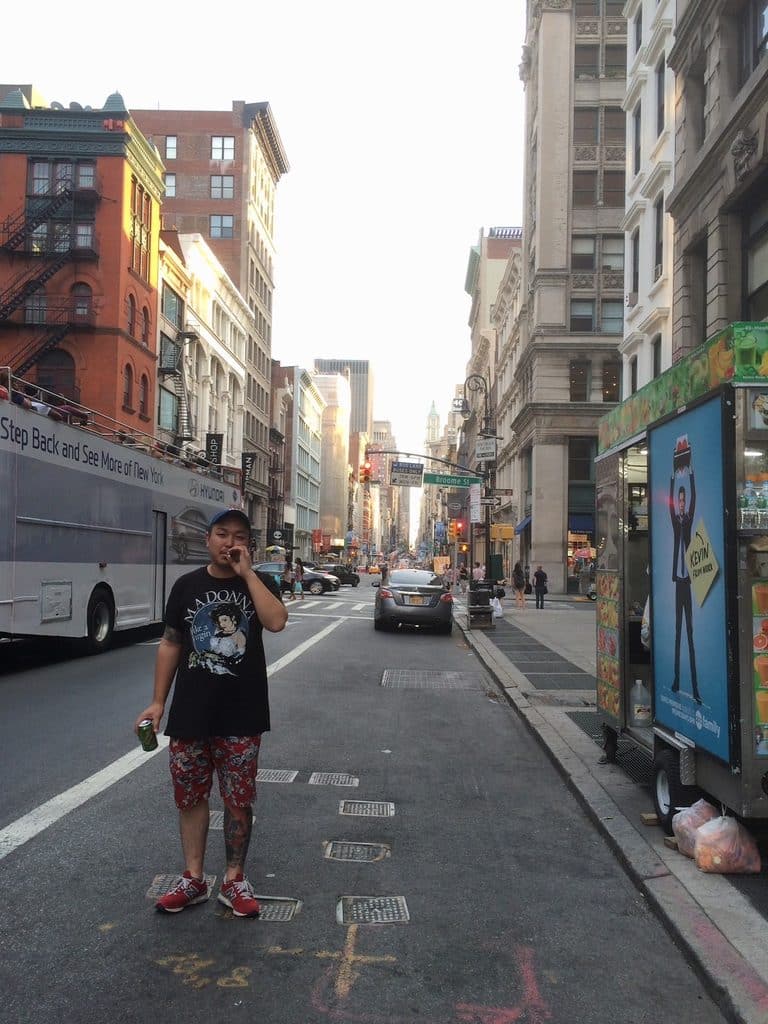
Growing up, he spent his days skateboarding. An unexpected injury eventually led him to the turntables, and before long, he found himself in New York, a center of HIP-HOP. There, he sharpened his skills in the city’s clubs, crossed paths with numerous artists, and even spent time in detention during a trip to Miami.
He certainly sounds like someone with a wild streak.
But the deeper our conversation went, the more that first impression began to unravel—in the best possible way.
His musical knowledge runs deep, and his approach to DJ techniques and track selection is remarkably analytical. He understands the business behind nightlife and takes a grounded, thoughtful approach to balancing his career, family, and music.
He may have an edge, but his feet are firmly on the ground.
He may seem larger than life, but he’s surprisingly considerate.
And above all, the man is absolutely hilarious.
Intellect and a wild streak. Two seemingly contradictory sides that somehow coexist effortlessly in the same man.
I sat down with DJ GRIND, Kansai’s very own maverick, for an extensive conversation about his introduction to HIP-HOP, his years cutting his teeth in New York, his misadventures in Miami, and the philosophy that guides his life today.
Now, where on earth do we begin?
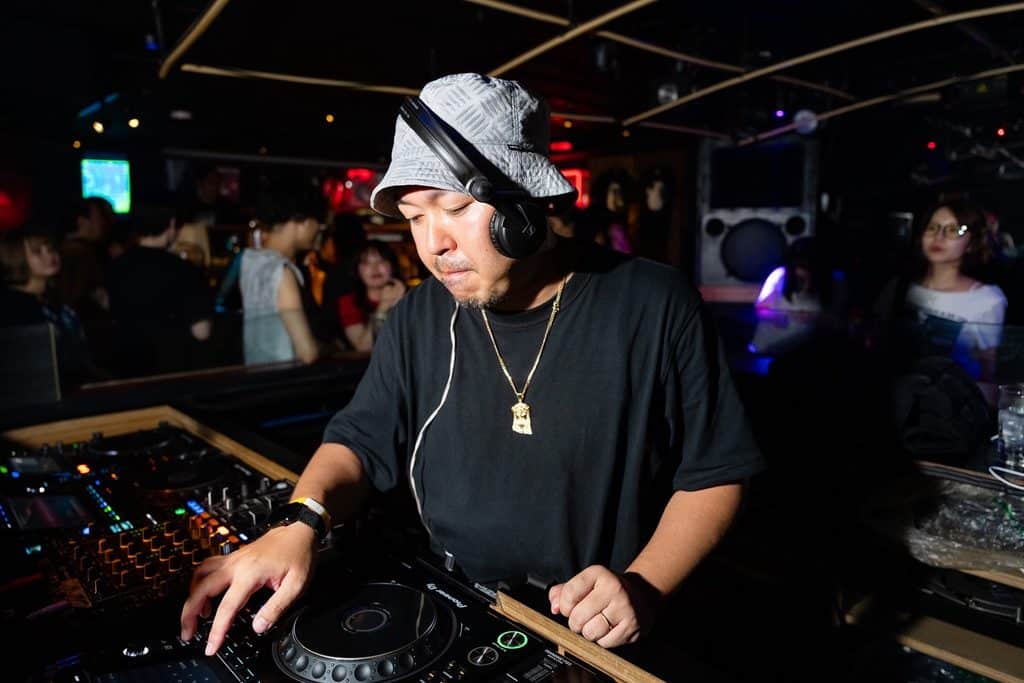
Chapter 1 | From Skateboard Kid to Turntables
SEI: First of all, where did the name DJ GRIND come from?
GRIND: Well, I used to be a skateboard kid. And “grind” is actually the name of a skateboarding trick. When I was in high school, there was this clothing store I used to hang out at, and HIDA from 韻踏合組合 (Infumiai Kumiai) worked there.
SEI: Oh, really?
GRIND: Yeah. He’s always been the kind of guy who comes up with names for people. He was like, “You skateboard, right? Then you’re DJ GRIND.” So HIDA gave me the name.
SEI: And you’ve kept it ever since?
GRIND: Never changed it.
SEI: I think it’s a great name. Did you discover HIP-HOP through skateboarding, too?
GRIND: These days you can watch anything on Instagram, but back when I was skating, the only way to see overseas skateboarders was through videos.
SEI: Right, of course.
GRIND: Exactly. So we’d watch VHS tapes, and baggy fashion was really popular back then. The videos used a lot of HIP-HOP, and that’s how I started thinking HIP-HOP was cool.
SEI: So it was the whole aesthetic that drew you in. Who were you listening to back then?
GRIND: A lot of those skate videos featured ’90s HIP-HOP, and there were plenty of underground instrumentals, too. Then the older guys at the clothing store started telling me I should listen to Jay-Z and stuff. New York HIP-HOP was huge at the time, so I was listening to Jay-Z, Ja Rule, Nas—all those guys.
SEI: We’re talking the late ’90s or early 2000s, right?
GRIND: Early 2000s. Jay-Z’s The Blueprint came out when I was in my second year of junior high school. That was 2001, I think. That album blew my mind.
SEI: What was the first record you bought? Jay-Z, by any chance?
GRIND: Yeah, actually. Jay-Z’s “Izzo” and Nas’s “Nas Is Like.”
SEI: The classics! Absolute classics. So how did you go from listening to those records to becoming a DJ?
GRIND: That’s actually a pretty funny story. I was really lucky with the people around me growing up. There were older guys in my hometown who I’d been skating with since junior high, and we’re still close today. One of them was Shinpei Ueno, who’s a legend in Japan’s skateboarding scene. He runs TIGHTBOOTH, which still makes apparel and videos.
SEI: Shinpei Ueno.
GRIND: That’s right. He’s about four or five years older than me. When he got a car, I was in my first year of high school, and he was like, “I’ll sell you my motorcycle.”
So I bought it. Then I got into an accident on that motorcycle, messed up my leg, and couldn’t skateboard anymore.
SEI: Was it a temporary injury?
GRIND: Yeah. I damaged some ligaments and stuff. Whenever I tried to skate seriously, my leg would really hurt, and it was taking forever to heal.
So I was sitting around thinking, “Man, I’m bored. What am I gonna do?”
Back then, there was a skateboard brand called ZOO YORK. They had this video series called Mixtape, and in the opening, DJ Craze was doing a routine.
I’d watched that routine back in junior high and thought DJing looked really cool.
So I figured, “Well, I’ve got nothing else to do. Maybe I’ll try DJing.”
That’s how I started, around my first or second year of high school.
SEI: How did you get your first equipment?
GRIND: Again, I got really lucky. My closest skateboarding buddy had an older sister who owned turntables and DJ equipment. She’d started working and wasn’t using them anymore, so she passed them on to me.
SEI: Lucky! That’s quite a chain of coincidences.
GRIND: Yeah, things like that seem to happen to me a lot.
SEI: They really do. It’s almost like things were falling into place. So who influenced you as a DJ back then? Craze, obviously?
GRIND: Craze was definitely someone I thought was incredible. And about ten years after I started DJing, I actually got to perform alongside him. I was able to tell him in person that he was the reason I started DJing. That felt really good.
SEI: Wow. That’s amazing.
GRIND: But as far as the DJs who really influenced me back then… let me think. DJ RYOW, definitely. His NEXT GENERATION series and mix CDs.
SEI: So you were listening to RYOW even back then.
GRIND: Yeah, I bought all kinds of mix CDs. SWING, GEORGE, LEAD—all those guys.
SEI: When was the first time you DJed in front of an audience?
GRIND: Probably my second year of high school. All my local skater friends suddenly started getting into rapping or DJing, so we decided to throw a party together in Minami, Osaka.
That was probably my first gig. And we actually got a huge crowd.
SEI: So you rented a venue and threw your own party?
GRIND: Exactly. We rented something like a live music venue in Amerikamura. It was just our friends. None of us knew anything about the actual club scene.
SEI: So it was your own little circle. How did you feel that night? Were you nervous? Excited?
Chapter 2 | “Forget Tokyo. I’m Going to New York!” — A Young Rebel and HARLEM
GRIND: I was just having fun.
SEI: Do you ever get nervous when you DJ?
GRIND: Not really. I’ve been DJing for about twenty years now, but there’s one place that still makes me nervous: HARLEM. (Laughs)
SEI: Why HARLEM?
GRIND: There’s a whole story behind that. When I was younger, HARLEM was a really big deal.
SEI: I can imagine. It still is now, of course, and it was back then too…
GRIND: Exactly. But for some reason, I had this attitude like, “I don’t want anything to do with HARLEM.” I had this rebellious streak.
SEI: You had an attitude. (Laughs)
GRIND: Yeah! (Laughs) It was almost like I hated Tokyo.
SEI: Ah…
GRIND: Exactly. I had this completely irrational rebellious streak.
SEI: An irrational rebellious streak.
GRIND: I was like, “If I’m gonna go all the way to Tokyo, I might as well go to New York!” I hated the idea of someone from Tokyo looking down on me just because they were playing in Tokyo. (Laughs)
I wanted to be able to say, “Well, I DJ in New York!” So I never made any effort to get bookings in Tokyo. And now, twenty years later, things have come full circle and I’ve been invited to play at HARLEM. I was like, “HARLEM!”
SEI: So, after coming full circle, both you and the turntables have ended up at HARLEM.
GRIND: Exactly. So it feels a little special to me.
SEI: That’s hilarious. Back when you first started DJing, did you have any particular vision of where you wanted your career to go?
GRIND: Not at all. I didn’t have any kind of plan. But I’d wanted to go to New York since my skateboarding days.
SEI: Oh, right! So your original motivation for going to America was skateboarding.
GRIND: Yeah. California and San Francisco have their own skateboarding styles, just like different places have their own musical styles. But New York looked cooler than anywhere else to me.
SEI: Were there any famous New York skateboarders you admired back then?
GRIND: There were. And culturally, the Osaka skate scene I grew up in was pretty East Coast-oriented. There was the whole SUPREME connection, and Shinpei Ueno was a ZOO YORK rider.
SEI: Really? I didn’t know that!
GRIND: Yeah. I don’t know how to explain it, but instead of people skating somewhere warm and sunny, I thought the guys skating in freezing weather with their hoodie hoods pulled up looked way cooler.
SEI: I see what you mean. Speaking of New York, when did you move there, and how long did you stay?
Chapter 3 | Brooklyn Streets, Manhattan Dance Floors
GRIND: Let’s see. I went to New York in 2010, and I stayed until just before 2014. So about three and a half years.
SEI: Three and a half years. Which part of the city?
GRIND: I DJed in Manhattan. It’s kind of like Nakameguro in Tokyo.
SEI: Nakameguro! That’s an interesting comparison. (Laughs)
GRIND: But I lived in Brooklyn.
SEI: Oh, Brooklyn. What was the New York HIP-HOP scene like in the early 2010s?
GRIND: It was crazy. When I first got there, Manhattan had these huge clubs dedicated entirely to trap music.
SEI: Oh, right. Trap was everywhere around that time.
GRIND: And those clubs started shutting down practically every week.
SEI: Wait, you mean now? Or back then?
GRIND: No, no, back then.
SEI: Every week?
GRIND: Yeah. Big clubs were closing left and right, and the whole nightlife landscape was changing.
And you know why? Because EDM arrived.
SEI: Ah, that makes sense.
GRIND: I think 2010 was the year Swedish House Mafia broke into the American market. There was this massive wave of four-on-the-floor music and progressive house. I think that was around the time open-format DJing started to emerge, too.
SEI: Interesting. So that was the turning point. What memories stand out from the clubs or the streets back then?
GRIND: Well, I was DJing in Manhattan, so EDM was everywhere in the clubs. But I lived in Brooklyn, where there were a lot of Black communities and a huge reggae and Jamaican presence. Jamaican music and culture were everywhere. Almost to the point of brainwashing! (Laughs).
That’s when I really started understanding what culture means. People would literally be listening to the exact same song at the exact same time. When a Vybz Kartel track was hot, you’d see Jamaican guys all over the neighborhood wearing Crocs. (Laughs)
And right around the time I moved to New York, Vybz Kartel got arrested. I honestly never thought he’d get out. There was this major road in Brooklyn called Flatbush Avenue, near where I lived. After Kartel was arrested, there were “FREE KARTEL” posters plastered all over the walls along that street.
I remember thinking, “Wow, that’s incredible.”
SEI: So the whole neighborhood was behind him. That’s incredible. Very New York.
GRIND: Yeah. That really left an impression on me.
SEI: Which artists or tracks were actually setting the dance floors on fire back then?
GRIND: In New York, for my generation, definitely Meek Mill’s “House Party.”
SEI: Meek Mill. Oh, absolutely.
GRIND: “House Party,” French Montana’s “Shot Caller”—that was around the time French Montana was breaking out. And of course, everybody was playing “Ni##as in Paris.” It was basically a competition to see who could drop “Ni##as in Paris” in the coolest way.
SEI: Really?
GRIND: That’s honestly what it was like. And Rick Ross’s “B.M.F.” was another huge one.

Chapter 4 | Breaking Into New York’s Clubs: Skill, Pride, and Determination
SEI: So how did you actually get DJ gigs back then? Was it through word of mouth and connections, or were you basically showing up and challenging people?
GRIND: More like challenging people.
SEI: Just walking in like, “I’m here. Let me play!”?
GRIND: Pretty much! There were a couple of Japanese DJs doing really well in New York at the time. One was DJ Martin, who’s in Tokyo now. Another was DJ NORI, an older DJ from Osaka who was really the only person I felt I could rely on back then—and still can today. Martin was getting so many gigs, and it drove me crazy.
But I figured if I just followed him around, I’d never surpass him. The funny thing was, he lived really close to me. And he’s genuinely such a nice guy.
SEI: Didn’t you two become friends?
GRIND: We were friends! We were!
SEI: Oh, you were friends.
GRIND: Yeah, we were friends. I just didn’t want to depend on him.
SEI: That’s some serious pride. (Laughs)
GRIND: Exactly. I didn’t want to rely on him. Sometimes I’d run into Martin on the train to Manhattan at night. I’d just be heading out to hang around some clubs, and I’d ask him, “Where are you playing tonight?” And he’d name some incredible club. I’d be thinking, “Seriously?”
So I decided I had to find my own way in. I’d go around telling people, “I’m a DJ from Japan. Let me play!” I said that to all kinds of people.
SEI: And did they actually give you a chance?
GRIND: Surprisingly, yeah. Quite a few did. And another thing about New York: people who still live there tell me the music selection hasn’t changed that much.
SEI: Really?
GRIND: Apparently, a lot of the tracks we were playing back then still work perfectly well today.
SEI: And that’s been what, ten or fifteen years?
GRIND: Yeah, about fifteen years.
SEI: That’s a long time.
GRIND: The way bookings worked over there was interesting, too. Let’s say the main DJ was getting paid $1,000 for the night. Usually, that was the only DJ the club actually booked. Then that DJ would bring in other DJs to handle the opening or closing sets.
SEI: Oh, so that’s how it worked?
GRIND: Yeah. The headliner doesn’t necessarily want to play all night. So I got opportunities to do opening and closing sets. And eventually, one club gave me an entire night because they thought I was a really good DJ.
SEI: So that opened the door to more gigs. New York is one of the world’s major DJ capitals, and there are so many talented DJs competing for opportunities. It must have felt incredible to have someone there tell you that you were good.
GRIND: It felt amazing. But at the same time, sometimes I wondered whether being a foreigner was actually helping me get those opportunities. There were moments when I felt like I was being treated differently.
SEI: Differently in a positive way?
GRIND: Yeah. I sometimes thought that if I’d been born and raised in New York, it might have been much harder to get into those same clubs.
You didn’t necessarily just pay a cover charge and walk in. There was a doorman, and if the doorman decided you could come in, you got in. That was pretty much how it worked.
SEI: I see. Although I imagine women might have had an easier time getting in.
GRIND: That’s another funny thing. I remember going to these really upscale clubs. Because I knew the doormen, I could get in wearing practically anything—a T-shirt, whatever.
But there would be these enormous lines outside. And women would literally grab onto my clothes, going, “Please, take me in with you!”
SEI: Oh, yeah. That happens.
GRIND: But the doormen could be absolutely brutal. They’d say things like, “You’re not getting in. Just because you’re a woman doesn’t mean you get to come inside.”
SEI: Wow. I’ve heard that people get selected based on their looks or how sexy they’re dressed. Wasn’t that the case?
GRIND: They’d straight-up say stuff like, “You’re ugly and your outfit sucks. You’re not getting in.”
SEI: They actually called women ugly? Wait. Seriously?
GRIND: Seriously! They’d say things like, “Come on, you know why you can’t get in.” No hesitation at all. I’d be thinking, “These guys are insane.” It was like the clubs were handpicking their customers.
SEI: Well, I suppose they were trying to maintain a certain atmosphere and clientele. Some kind of quality control, in a sense.
GRIND: Think of it like a Japanese hostess club. I actually think one reason nightclubs aren’t as popular in Japan is because the country already has such a strong hostess-club culture.
Over there, promoters bring attractive women to the tables where the wealthy customers are spending money. So when they’re looking at the line outside, they’re picking women they think would fit in at those tables.
SEI: Yeah, absolutely.
GRIND: Exactly. From my perspective, a lot of those people weren’t necessarily coming to enjoy the club itself. It felt more like aspiring models showing up hoping to meet wealthy patrons. Those were the kinds of high-end clubs I’m talking about.
SEI: I can definitely relate to that. I probably shouldn’t say this, but bringing an attractive friend along really did improve your chances of getting into certain clubs.
GRIND: Oh, absolutely. If you had a cute Asian girl with you, you were practically unstoppable.
Chapter 5 | Busta Rhymes, Rihanna, and Legends on the Streets of New York
SEI: Thank you for giving us such a real look into New York’s nightlife. Now, were there any unforgettable encounters with DJs or MCs during your time there?
GRIND: Let’s see. There was this time when Bruno Mars had only just started making a name for himself.
SEI: Bruno Mars!
GRIND: I was at this really upscale club, the kind of place where I wasn’t even getting DJ bookings yet. I’d tagged along with some DJs I knew and was hanging out in the booth. Bruno Mars came by just to have a good time, and he went around greeting all the staff.
SEI: I’ve heard he’s a really nice guy.
GRIND: He really is. Just a genuinely decent person. You could tell he had good manners.
SEI: Oh, that’s good to hear.
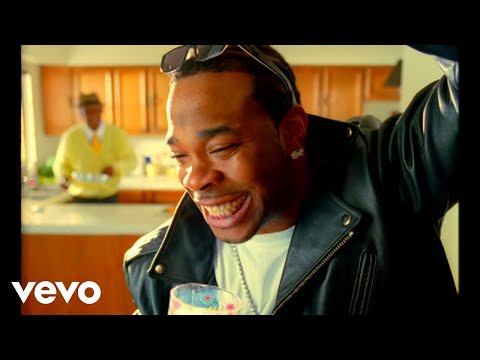
GRIND: And then there was Busta Rhymes.
SEI: Wait, Busta? You met Busta Rhymes? I’m so jealous!
GRIND: Busta was incredibly cool.
SEI: I can imagine!
GRIND: You know how “Arab Money” became such a huge hit in New York before I got there? Apparently, Busta had been handing out USB drives to DJs himself, asking them to play his track.
SEI: Wow. And he was already an OG at that point!
GRIND: Exactly. He was out there personally giving DJs his music and building the buzz from the streets up. I thought that was incredible.
And the thing about Busta was, you’d see him in clubs all the time. Back then, his track with Chris Brown, “Look at Me Now,” was huge. Whenever it came on, he’d sometimes grab the mic and perform that rapid-fire verse right there in the club. Those were the kinds of things that made New York special.
SEI: You actually got to see Busta Rhymes rap live like that? That’s amazing!
GRIND: Speaking of Busta, I’ve got another really funny story. Completely unrelated, though.
SEI: Please! I’m all ears.
GRIND: I don’t know if they do this in LA, too, but in New York, they’d sometimes have these free block parties in elementary school playgrounds, almost like neighborhood summer festivals.
SEI: It depends on the neighborhood in LA. That particular setup might be more of a New York thing.
GRIND: Really? Yeah, it was kind of like a summer concert series.
SEI: That sounds great.
GRIND: There was an elementary school just a few blocks from my apartment, and they announced that Salt-N-Pepa and—
SEI: Wait, Salt-N-Pepa? I absolutely love them!
GRIND: Yeah! Salt-N-Pepa and Naughty by Nature were doing a free show. So I thought, “It’s free, and it’s right down the street. Of course I’m going.” I went over, and for some reason, Busta Rhymes suddenly showed up.
SEI: Well, Treach and Pepa were married and have a child together, and I’m sure Busta knows them, too. They probably all have connections.
GRIND: Right. So I was standing there thinking, “Wow, it’s Busta!” And apparently he said something like, “I was just walking past the school, heard Salt-N-Pepa performing, and decided to come in.”
I was like, “This dude is unbelievable!”
SEI: The man’s got connections everywhere, and apparently he’ll show up anywhere, too!
GRIND: He literally just picked up a microphone. Then he asked the DJ, “You got any of my tracks?” They put on “Light Your Ass on Fire,” and he performed it right there.
I remember thinking, “Man, this guy must genuinely be a good dude.”
SEI: Any other good New York stories?
GRIND: Oh, I’ve got another one. Another story that won’t disappoint.
SEI: Please, go ahead.
GRIND: Brooklyn had these block parties, too. DJ SARASA was actually DJing at one of them.
SEI: Right, right.
GRIND: They had all these legendary artists from back in the day—A Tribe Called Quest, Pete Rock & CL Smooth, Nice & Smooth. It was a block party with a tribute set for Guru.
I was supposed to go with some friends, but I’d been DJing the night before and overslept like crazy. They left without me. So I finally got to the station, but I had absolutely no idea where the event was.
I started walking around and spotted two Black guys ahead of me. I figured, “Those guys look like they’re going to the block party. I’ll just follow them.” So I started walking behind them.
Eventually, they turned around and asked, “You here for the block party?” I said, “Yeah!” And they told me, “You can’t get in from this side. The entrance is over there.”
I thanked them, and then they said, “We’re about to perform. Make sure you watch us.” I was thinking, “Perform? Who are these guys?”
Turns out it was Nice & Smooth.
SEI: No way! You didn’t recognize them?
GRIND: Not at all. (Laughs) I wasn’t really that interested in those older-school artists.
SEI: (Laughs) Well, they’re from a different generation than yours. But that’s incredible. In New York, you could just run into legendary artists on the street.
GRIND: Exactly. Another time, I was walking through Brooklyn and saw this older guy with dreadlocks. Someone said to me, “Yo, you know who that is?” I was like, “Who? That old dude?”
Turns out it was Shabba Ranks.
Editor’s note: Shabba Ranks is a Jamaican dancehall and reggae artist who was active in the late 1980s and 1990s and is also known for his crossover with HIP-HOP.
SEI: You called Shabba Ranks “that old dude”? (Laughs)
SEI: Any other memorable encounters with artists or DJs?
GRIND: Actually, yeah. There was this club with about three different levels.
SEI: Like a first floor, second floor, third floor?
GRIND: Yeah. There was a rooftop, and then this super-exclusive VIP area. The VIP room had its own DJ booth, but there was literally nobody there. So I was playing some pretty mellow music.
Then someone came over and told me, “The rooftop is packed. You need to turn up the energy!” So there I was, playing full-on EDM to an empty room.
SEI: Wait, they made you do that? Even though nobody was there?
GRIND: Exactly. So I couldn’t tell how the crowd was reacting.
SEI: So what happened?
GRIND: As the night got later, all of a sudden, people started flooding into that super-VIP area. The place filled up.
Then this beautiful woman tapped me on the shoulder. I figured she wanted to request a song.
I turned around. It was Rihanna.
SEI: Are you serious?! So she wasn’t making a request?
GRIND: Nope.
SEI: What did she say?
GRIND: She just came over to say hello.
SEI: Just like, “Hi!”? Wow.
GRIND: Yeah. And the club manager had specifically told me, “Don’t play too many Rihanna songs.” So naturally, the second track I played was “We Found Love.”
SEI: You completely ignored the warning!
GRIND: Didn’t listen to a word of it.
SEI: Clearly!
GRIND: I just couldn’t resist playing it! (Laughs)
SEI: That’s hilarious. Now, let’s talk about the connections and competition between DJs in New York at the time. What was that scene like?
Chapter 6 | Inspired by DJ AM: Learning How to Play HIP-HOP
GRIND: Well, one of the biggest reasons I wanted to go to New York and DJ in the first place was DJ AM.
You know, Nicole Richie’s ex-boyfriend.
SEI: Oh! DJ Yuko mentioned DJ AM as one of the DJs she admired in her interview, too.
GRIND: Yeah. He’d been based in Miami for a long time. There was a club called M2 in Miami, and apparently a club by the same name opened in New York. I heard AM moved to New York to become a resident there, around 2008 or 2009.
Editor’s note: This is GRIND’s recollection. Event listings from 2009 describe New York’s M2 as the former Mansion, and the present M2 in Miami Beach opened in March 2023. HIPHOPCs has not confirmed the full history of the venues.
I was only about nineteen or twenty at the time, but I thought I could do it. I was thinking, “I could DJ with AM!” I really wanted to see him perform, and I wanted to play alongside him. But I wouldn’t turn twenty-one until 2010.
SEI: Right. The age restriction.
GRIND: I wasn’t old enough to get into the clubs yet.
SEI: Right.
GRIND: Exactly. I had to wait until I turned twenty-one. But about six months before I was supposed to go to New York, AM passed away.
SEI: Oh, man. What terrible timing!
GRIND: There was nothing I could do about it. But I went to New York anyway. And after AM passed away, this DJ agency called 4AM had been established there. It was basically a team that represented DJs and sent them out to different venues.
The name 4AM had a few meanings behind it—something like “for AM,” as a tribute to DJ AM, and also the fact that New York clubs close at four in the morning.
They had some really talented DJs on the roster. Jus Ske, who DJed for Pharrell, was one of them. SINATRA was another. There were all kinds of great DJs involved.
So if you went to a 4AM party, you knew you were going to hear really high-level DJing. I went to their parties constantly.
SEI: That must have really trained your ears.
GRIND: Definitely. But I think the rise of 4AM also meant that quite a few DJs probably lost their resident spots.
SEI: Ah, I see.
GRIND: It felt like the scene was becoming much more business-driven.
SEI: More capitalist, in a way?
GRIND: Yeah. It was one of those moments when I realized that getting booked wasn’t necessarily just about how skilled you were as a DJ.
SEI: How did your experience in New York influence your DJing style and your relationship with music afterward?
GRIND: I think my ability to play HIP-HOP properly improved tremendously.
When Japanese DJs mix different genres, a lot of them aren’t very good at playing HIP-HOP.
SEI: That’s an interesting observation, especially coming from a Japanese DJ who’s worked in both Japan and the United States.
GRIND: Sometimes I hear it and think, “No, that’s not how you do it!” Let me give you an example. I know Morning Musume (モーニング娘。) songs, right? In the same way, people overseas know Drake songs.
SEI: There was a period when Drake was a little tricky to play in LA, but generally speaking, his music is a pretty reliable way to get a crowd going.
GRIND: But that’s the thing. Drake is one example for New York. You have to understand how to play Kendrick Lamar, too.
SEI: Ah, I see what you’re getting at.
GRIND: Or how to play Snoop Dogg. For my generation, it’s tracks like Dr. Dre’s “Xxplosive” or Luniz’s “I Got 5 on It.” Those are songs everybody knows.
They’re HIP-HOP tracks that are practically guaranteed to work. But a lot of Japanese DJs don’t know how to bring those tracks into a set effectively.
SEI: I suppose that’s because they haven’t experienced those particular dance floors firsthand.
GRIND: Exactly. If you’ve only ever played HIP-HOP parties for Japanese audiences, you probably won’t notice it. You don’t realize how powerful HIP-HOP can be when it comes to suddenly changing the flow of a set that mixes genres for an international crowd.
SEI: Right. That makes sense.
GRIND: It’s different, isn’t it?
SEI: It really is.
GRIND: So being in New York taught me how to drop something like “Xxplosive” at exactly the right moment and absolutely set the room off. Those songs never die.
SEI: So you can still play them anytime.
GRIND: Absolutely. Same with dead prez’s “Hip Hop.” It’s about knowing how to build up to a track, how to bring it in, how to make it hit. You hear someone do it and think, “Oh, so that’s how you’re supposed to play that!”
Or Jay-Z and Kanye’s “Mercy.” I don’t think I would have understood the power of those records if I’d only stayed in Japan.
Editor’s note: “Mercy” is credited to Kanye West featuring Big Sean, Pusha T, and 2 Chainz. Jay-Z is not a credited performer on the track. See the official music video.


Chapter 7 | Every Day in New York Was Like a Comic Book
SEI: Before we move on from your New York years, is there anything else you’d like to share? I’m sure I could keep asking questions all day, but I’d love to hear any stories you particularly want to tell.
GRIND: Well, this has absolutely nothing to do with DJing, but… When I first moved to New York, I was broke. I was trying to save money on laundry, so I’d take literally every pair of underwear I owned to the laundromat. I’d be standing outside in shorts, wearing no underwear, nervously smoking a cigarette while I waited for everything to wash.
Then one day, this really beautiful white woman came up to me and said, “Hi.”
I turned around. She was topless, with a camera hanging around her neck. And I thought, “Man, I still have a long way to go in America.” (Laughs)
SEI: Are you seriously okay with me publishing that?
GRIND: Absolutely! I realized a guy like me still had a lot to learn.
SEI: I see. So standing outside a laundromat, going commando and smoking a cigarette, was still amateur hour by New York standards.
Well, I’m glad you had such an enlightening experience. You’ve already shared some pretty outrageous stories, but was there anything about New York’s HIP-HOP scene back then that would be almost impossible to imagine today?
GRIND: Something you couldn’t imagine today? That’s a tough one. Honestly, every day felt like something out of a comic book.
SEI: A comic book?
GRIND: There was this tiny club—seriously, thirty people would have packed the place. Actually, calling it a club might be generous. It was more like the basement of a restaurant.
A friend of mine was doing the opening DJ set, so I went to check it out. I remember thinking, “How does a party even work in a place this small?”
Turns out it was some NFL player’s private birthday party. There were hardly any people there, but French Montana was performing live.
That blew my mind.
SEI: Wow. I guess they must have been friends.
GRIND: Of the thirty people there, about ten of them seemed to be Coke Boys. There were so many people connected to French Montana.
SEI: So a lot of them were probably part of his circle.
GRIND: Yeah. Seeing people spend unbelievable amounts of money in these tiny venues completely changed how I thought about clubs. I stopped assuming that bigger automatically meant cooler.
SEI: Ah, I see. Quality over quantity, in a sense. A bigger venue isn’t necessarily a better one.
GRIND: Exactly. New York didn’t actually have that many enormous clubs. Even 1 OAK, which was a high-end nightclub, wasn’t that big.
The business model wasn’t necessarily about packing as many people as possible into a room and making money from drink sales. It was more about increasing how much each customer spent and taking good care of them.
SEI: That makes sense.
GRIND: The whole concept of what a nightclub should be was different.
Chapter 8 | Miami Misadventures: Jail, Oatmeal, and Fudō Myōō
SEI: Thank you. Now, there’s something I’ve heard through the grapevine, and if it’s off-limits, we’ll cut it. I heard a rumor that you once spent some time in jail in Miami. I won’t ask why, but would you be willing to tell us about the experience, as much as you’re comfortable sharing?
GRIND: Yeah, I got arrested while I was on vacation.
SEI: I was wondering what you were doing in Miami in the first place. So you were just there on vacation?
GRIND: Yeah. I went on vacation and somehow got arrested. (Laughs)
SEI: My condolences. So what was daily life like in there? How did your day begin and end?
GRIND: Well, at first, they put everybody in the same kind of holding area. Didn’t matter whether someone had k***ed someone or shoplifted.
SEI: Regardless of how serious the alleged offense was?
GRIND: Yeah. I’d never been arrested in Japan.
On the day I was arrested, I had an initial court appearance. They went over things like what the prosecution was saying and whether you’d have a private attorney or a public defender. So they took me to court.
I ended up with a public defender, and then they put me on a bus and took me to this huge holding area. There were about fifty bunk beds, so roughly a hundred people in one room.
SEI: Wow.
GRIND: And at that point, I was still wearing my own clothes.
SEI: Oh, everyone was in regular clothes?
GRIND: Not everyone. People who’d been there longer weren’t.
SEI: They were wearing orange, right?
GRIND: Exactly. I think I spent about two days there in my own clothes. There weren’t any clocks, so I completely lost track of time.
SEI: I can imagine.
GRIND: Then one time, while I was sleeping, they suddenly woke me up. They took about five of us away, put us on some mysterious bus, and drove us through what felt like ten different electronic security gates.
SEI: Ten gates? Wow.
GRIND: Then they told all of us to face outward and put our hands behind our backs.
SEI: Like something you’d see in a movie.
GRIND: Exactly. They called our names and threw these enormous bags at us from behind. But everybody had their hands behind their backs, so when the bags hit us, we’d stumble or fall over.
Then they told us to pick up the bags and go to our assigned rooms. Inside the bags were orange uniforms, bedding, and stuff like that. We’d been moved to an area with people who were there for relatively minor offenses.
SEI: So they’d transferred you somewhere else.
GRIND: Yeah. And that place was almost like you could watch movies twenty-four hours a day and drink as much juice as you wanted.
SEI: That sounds almost like an internet café!
GRIND: Right? I ended up staying there for about two or three weeks. It was actually pretty peaceful.
SEI: Peaceful? That’s good. Did you have a roommate?
GRIND: It was a big shared room, probably around twenty people.
SEI: Ah, so it was a dormitory-style setup.
GRIND: Yeah. Some of the guys were older homeless men who’d been arrested for shoplifting.
SEI: Shoplifting grandpas.
GRIND: Yeah. They’d be like, “Hey, at least I get free meals in here.”
SEI: Apparently, that’s a universal phenomenon.
GRIND: One old guy was basically saying, “Even if they let me out, I’ll just shoplift again immediately!”
When we got to that unit, we’d wake up around six in the morning. Then we’d have free time.
At around two in the afternoon, we’d get to go outside for about an hour and a half to play basketball or exercise. After that, more free time, then sleep.
That was pretty much the whole routine. And from that area, you could actually see outside.
SEI: You could see outside from your room?
GRIND: Yeah, you could.
SEI: I’ve heard people talk about how much they miss seeing the outside world when they’re locked up. Sometimes all they have is a tiny window.
GRIND: That place felt kind of like kindergarten.
SEI: Kindergarten? Kindergarten for inmates? (Laughs) What a description!
GRIND: And from the exercise yard, you could see this enormous black tower.
SEI: A tower?
GRIND: Yeah. I asked somebody what it was, and they told me it was this place in Miami they called “Mega Jail.”
They told me it was only for people serving life sentences, and that there were no officers inside, because “they’d d** anyway.”
SEI: Oh, wow.
GRIND: So I asked one of the guys, “What would happen if I ended up in there?” He told me, “You? You’d d** within an hour.” He said inmates would bully and k*** newcomers for their own amusement.
SEI: That’s a terrifyingly casual way to talk about someone’s life.
GRIND: I was thinking, “That’s scary.”
SEI: So you had a mugshot taken, too?
GRIND: Oh, yeah. They took my mugshot. And they fingerprinted parts of my hands I didn’t even know could be fingerprinted. I asked them for a copy of my mugshot, but they wouldn’t give it to me.
SEI: I suppose they wouldn’t give you a copy. (Laughs) Did you already have tattoos back then?
GRIND: Yeah, which made me incredibly popular! (Laughs)
Editor’s note: This article presents DJ GRIND’s tattoos, appearance, and self-expression with respect for his individuality.
SEI: I can imagine. Traditional Japanese tattoos really attract attention overseas.
GRIND: Exactly. I’ve got Fudō Myōō tattooed on my leg.
SEI: Oh, that’s cool.
GRIND: One of the guys asked me, “What is this?” He was looking at the tattoo and going, “This guy is really on fire. What is he?”
SEI: “Why is he surrounded by flames?” (Laughs)
GRIND: I didn’t really know how to explain it. And trying to explain it in English was even harder.
SEI: Of course! Fudō Myōō isn’t exactly easy to explain off the top of your head, even in Japanese.
GRIND: So I just told him, “Fire God in hell.” (Laughs)
SEI: Americans really do love tattoos. People get so excited when you show them Japanese-style tattoos.
GRIND: We’d have these morning roll calls where everybody had to line up. And one day, for some reason, I was the only one they called into the officers’ room.
I was wondering what was going on. It turned out they wanted to see my tattoos. They made me take off my clothes in front of the officers.
SEI: They probably just wanted a closer look! You don’t see that kind of tattoo every day. They might have thought you were “893.”
A lot of Japanese HIP-HOP heads have tattoos, but traditional Japanese work really gets attention overseas.
GRIND: Oh, definitely.
SEI: But here’s what I don’t understand. How can you have all those tattoos and still be afraid of needles? You say you’re scared of injections, but personally, I’d be much more afraid of getting tattooed!
GRIND: Because I just can’t deal with something making a hole in my body like that.
SEI: But doesn’t getting tattooed hurt even more?
GRIND: It really hurts.
SEI: Exactly!
GRIND: Actually, it doesn’t hurt that much.
SEI: Which is it?! (Laughs) Anyway, thank you for sharing all that. You met all kinds of people and went through some unforgettable experiences in there.
Did any of it change how you think about relationships or life in general?
GRIND: Well, I learned that if you screw up, you can get arrested.
SEI: Fair enough. That’s certainly something to keep in mind.
GRIND: Yeah. I learned that you’ve got to live your life properly.
SEI: By the way, what did you do during all that free time?
GRIND: I’d watch random Spanish-language movies with the old guys, play bingo, and do crossword puzzles.
SEI: That’s not jail. That’s a retirement home! (Laughs) What about the food?
GRIND: I ate so much oatmeal.
SEI: Oatmeal…
GRIND: Yeah. Oatmeal, something like chicken cutlets, salad, sandwiches.
But the oatmeal was absolutely terrible.
SEI: Well, oatmeal is a pretty standard American breakfast.
GRIND: Some days they’d serve it like rice. Other days they’d turn it into a dessert. Sometimes they’d be like, “Here, put maple syrup on it.” (Laughs)
SEI: The idea that it turns into dessert some days is hilarious. People mix in sugar or put maple syrup or honey on it, right?
GRIND: But it tastes awful!
SEI: It does! People try to disguise the taste with maple syrup. But a lot of Americans genuinely like it. It’s a breakfast staple.
GRIND: Exactly. One day you’re eating oatmeal with salt, and the next day you’re eating it with maple syrup.
SEI: Right! It’s a bit like beans—salted beans in Mexican dishes, or beans sweetened with sugar to make anko for Japanese sweets.
GRIND: Seriously, that stuff is %$@#+* food.
SEI: No, no, no! You can’t say that! We’re going to have to find a different way to describe that particular opinion. But I know what you mean.
GRIND: So I told this old guy I was hanging out with, “Man, I don’t think I can eat this.” I offered him my oatmeal. And he said, “You won’t get enough nutrition if you don’t eat!”
So he gave me his dessert in exchange. We kept trading food like that the whole time.
SEI: It sounds like you had some warm, friendly exchanges with that older man. How did you build trust with people inside? Was it through sharing food and showing each other your tattoos?
GRIND: Honestly, they were all like bad comedians, and we got along well.
SEI: So it was actually a pretty friendly atmosphere. I’m glad to hear that. Well, it sounds like you came away with quite an experience.
GRIND: It was a good experience.
He chased his dream in New York and unexpectedly spent time in detention in Miami. But DJ GRIND’s story does not end there.
What changes in his life and outlook awaited him after he returned to Japan, and what HIP-HOP philosophy does he stand by?
Part 2 explores this maverick’s way of doing things. Read Part 2 (in Japanese).
DJ GRIND | Official Links
Read more HIPHOPCs original interviews in English.