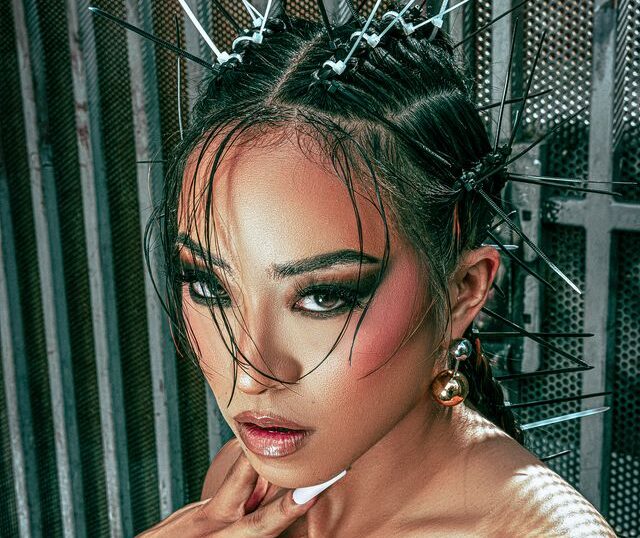
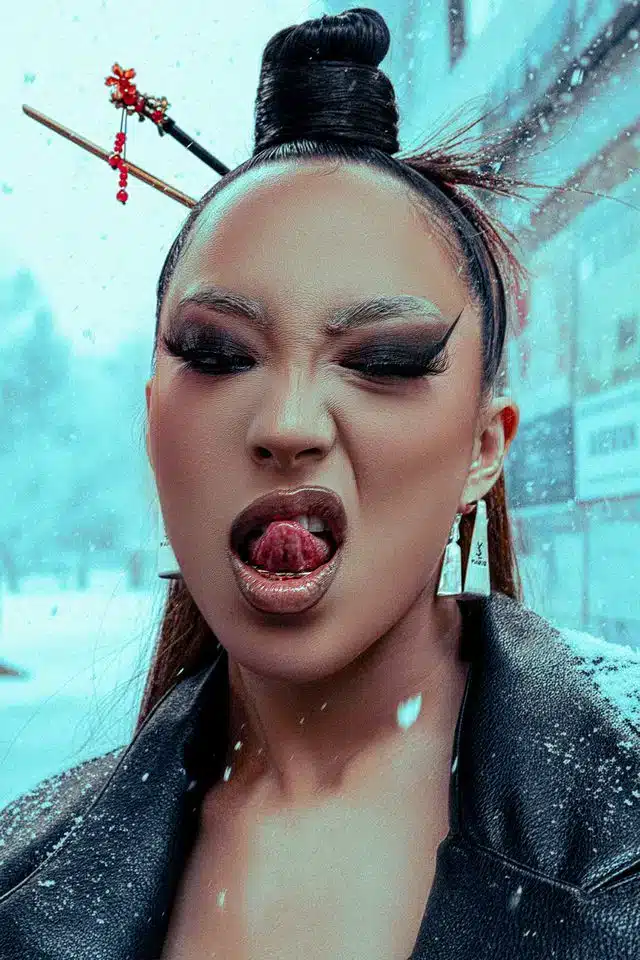
via @yayoidaimon instagram
Some people are simply born to be stars. That was my immediate impression when I first met Yayoi Daimon. As someone who has never worked outside the music industry since graduating high school, she knows exactly how to present herself, how to express, how to captivate. The gold grillz that flash every time she smiles. A slow, deliberate way of speaking that suddenly lights up with a spark in her eyes when the topic excites her — she possesses an undeniable magnetism that draws you in. A born artist, I thought. That phrase was made for someone like her.
On a Saturday afternoon in January, at a Thai restaurant in LA’s Koreatown that she had chosen for our meeting, a tall, striking woman appeared pushing a stroller with her adorable baby daughter. I had brought my six-year-old son along, leading to what might be the industry’s first parent-to-parent interview. Joining us remotely from Japan was Cook Oliver, a self-proclaimed Yayoi Daimon superfan and fellow HIPHOPCs contributor. Pay close attention to the second half of this piece — Cook’s questions come from a true fan’s perspective and cut deep in ways only a dedicated follower could.
In Her Own Words: Who Is Yayoi Daimon?
Sei: So, I’m sure anyone in the Japanese hip-hop world already knows you, but for readers who are just getting into hip-hop, could you give us a quick introduction?
Yayoi: Introduction. Umm. I sing. I’m Yayoi Daimon. I sing and rap, but officially, I’m a singer-songwriter.
Sei: You write your own material too, right?
Yayoi: Yes. I’ve been based in Los Angeles since 2024.
Sei: When did you debut?
Yayoi: If we go way back, I debuted in 2010 with a girl group called “rhythmic.” This was during the super early era of what would eventually become K-pop idol culture — we were a girls’ unit right at the beginning of that wave. After about three years as an idol, I transitioned to a solo career.
Sei: Back then you were singing and dancing?
Yayoi: Singing and dancing, but dance was the main thing. And before that, I was a hip-hop dancer in Osaka’s underground scene.
Sei: How old were you then?
Yayoi: About 16 or 17. I was a kid, but I was performing at nightclubs with adults. (laughs)
Sei: Nightclubs! (laughs) I see. So your entry into hip-hop was through dance?
Yayoi: Yes. When I was 13, Rihanna came to Japan for her debut tour. I think it was Namba Hatch in Osaka — a venue that holds about a thousand people, all standing. I was 13 and pretty short, so I thought, “I’m getting to the front row.” I pushed my way through all the other people and got right up to the stage. That’s where it all started for me.
Sei: Seeing Rihanna live.
Yayoi: Rihanna live. Right at the front. It was my first time experiencing a live Black artist up close.
Sei: Was Rihanna beautiful? Cute?
Yayoi: Of course! But honestly, at the time, I was more captivated by Rihanna’s dancers — they were so incredibly cool.
Sei: Ahh, I see.
Yayoi: Being right at the front of the stage, almost close enough to touch the dancers. You’re absolutely not supposed to do that, but — you’re absolutely not supposed to! (laughs)
Sei: (laughs) That’s amazing! So from there you got hooked on hip-hop — well, on dance.
Yayoi: Yes.
Sei: You call yourself a singer-songwriter — when did you start writing?
Yayoi: I started writing seriously after the girl group activities ended. But before that, dance was really my main focus, so I was always listening to music for the rhythm rather than the lyrics. When I actually started writing, I really had no idea what I was doing — completely clueless.
Sei: Did you have a mentor back then?
Yayoi: I met one person who made techno. He taught me about beats and production, but the lyrics — that was completely self-taught.
Sei: Self-taught! You just figured it out on your own. Song lyrics and rap verses are completely different things, right? You write your own bars too?
Yayoi: Yes.
Writer’s Block After “Heels de Niodachi”
Sei: What made you start rapping?
Yayoi: Hmm. I’ve always loved hip-hop. For me, there’s no real boundary between singing, rapping, and dancing. While I was exploring different styles and wanted to try all kinds of things, I made “Heels de Niouji” (Standing Tall in Heels).
Sei: That track is super famous. Cool, and so sexy.
Yayoi: Thank you. That song was produced by SHINGO★Nishinari — everyone knows him, of course — a legendary rapper and one of Osaka’s greatest. I wrote the lyrics, but SHINGO-san basically rewrote almost all of them.
Sei: I absolutely love that track. And the fact that it’s rapped in Kansai dialect — that was groundbreaking. I was genuinely shocked. All I could think was: this is incredible.
Yayoi: Thank you. I love it too. But precisely because the lyrics were so incredible — because SHINGO-san wrote them — the pressure that came after was overwhelming. Like, “What the hell can I possibly write next?”
Sei: Yeah, that makes total sense.
Yayoi: So I hit a serious writer’s block. When it came time to write “NO BRA!,” I was deep in it.
Sei: Oh no.
Yayoi: The recording session was booked, everything was scheduled, so I absolutely had to write something. But no matter how many all-nighters I pulled, nothing came. My mind was completely blank.
Sei: Full-on writer’s block.
Yayoi: Yes. That kept going and going. Finally, in desperation, I wrote something right there during the recording session itself. When I showed it to producer XLII, he said, “This is great!” But I just couldn’t accept it. SHINGO-san’s lyrics had been so incredible that everything coming out of me felt like absolute garbage. It became this enormous pressure.
Sei: So even you went through something like that…
Yayoi: That one word of encouragement from the producer saved me. The song got made, and thankfully it became a track that everyone loved. But that might have been the worst writer’s block I’ve ever experienced. It was in the early days.
Sei: The early days? So that was one of the toughest, most painful moments of your career as a rapper?
Yayoi: Yes. I was truly a lyrics beginner at that point. Suddenly a legend’s guidance appeared, and I was writing expressions I never could have come up with on my own. The period when the Japanese scene started paying attention to me might have been the exact same period when writing was the most painful.
Sei: On the flip side, is there a moment when you felt glad to be an artist?
Yayoi: Every moment. I’ve been doing music since I was young, and honestly this is the only job I’ve ever had. I debuted right out of high school. Music and teaching dance — that’s literally all I’ve ever done. I can’t really imagine any other life. But if I had to pick one thing — live performances. That’s what I love most.
Sei: You were born to be an artist.
Yayoi: (laughs) Thank you. I hope so. Right now, being based in LA, I don’t have the weekly shows with fans coming out like I did in Japan. That routine is gone for now.
Sei: Right, right. But you’re spending a different kind of important time in your life right now.
Yayoi: It’s like… a solitude before the next phase. A period of preparation.
Navigating a Male-Dominated Industry
Sei: The “next phase.” I see. Going back to “Heels de Niouji” — that strong female image. Was that a persona you created, or the real you?
Yayoi: Honestly, back then, it was the woman I aspired to be. The image I wanted to become. Now I think I’ve actually reached about that level of confidence. (laughs)
Sei: (laughs) Yeah, living in America does make you stronger.
Yayoi: It really does. And becoming a mother helped too.
Sei: Right, right. Speaking of being a woman — hip-hop is male-dominated in both Japan and America. Female rappers face extra scrutiny. A man can rap about explicit content and nobody blinks, but when a woman does it, she gets called vulgar — from both men and women. Did you experience that in Japan?
Yayoi: Oh, absolutely. Especially back in the day. There were more girls in the dance scene, but I also worked in the reggae world. These days, both reggae and hip-hop have so many strong, independent women doing their thing. But when I was really young, there were almost none.
Sei: You were really a pioneer in that sense.
Yayoi: So yeah, hmm, I wouldn’t call it outright discrimination, but I constantly felt disadvantaged. That’s probably exactly why I wanted to become someone like the woman in “Heels de Niouji” — that strong image. I wanted it badly.
Artists She’s Watching: Asian Artists Breaking Through
Sei: Thank you. Any artists you respect or are watching right now?
Yayoi: Artists I’m watching? As an Asian trying to make it in America, I’ve been paying close attention to KHANTRAST — he’s Chinese, an immigrant doing his thing in New York. He didn’t come as one of those wealthy “rich Chinese” international Asians. He built himself up from nothing in Brooklyn as an immigrant, and his lyrics reflect that struggle. A lot of artists who come to LA from other countries already had success back home. But I came because I love American music and wanted to build my foundation here. I didn’t come after reaching the status I wanted in Japan. I didn’t roll in with a big team to make some flashy entrance like some artists do. So KHANTRAST’s immigrant struggle, that grind… it really resonates with me. And right now in America, K-pop is obviously blowing up, but —
Sei: Yeah, around here (the interview took place in Koreatown) in LA there are tons of Korean Americans. Korean-American rappers too.
Yayoi: Within all that, KHANTRAST probably has more Black fans than Asian fans. And that’s something that fills me with pride as an Asian. It’s inspiring. For women, SAILORR — she’s Vietnamese-American but she proudly puts Asian culture front and center in her work.
Sei: Right, right, right.
Yayoi: Her fanbase is probably mostly Black too, since she does R&B. So there’s this surprise and joy — like, “Asians are breaking through in this genre too!”
Sei: There are a lot more Asian rappers in America these days.
Yayoi: Just a few years ago, this was unthinkable. The older generation might have felt like even if you lived in America, you still had to keep your base in Japan. But even those barriers are now being broken by new pioneers. That’s a massive source of inspiration and hope for me, and I truly feel honored to be living in America during this era.
Sei: If you’re rapping here in the US, is it in English or Japanese?
Yayoi: The unreleased songs I have right now are about 90% English.
Sei: 90% English! Wow. I’m excited. Though mixing Japanese and English could be really cool too.
Yayoi: Mixing could be interesting, yeah. But I want to develop the skill where an American can hear it once and immediately understand. That’s the goal.
Sei: Can’t wait. Alright, let me connect you now with Cook Oliver, HIPHOPCs’ resident heartthrob writer, calling in from Japan.
Roots: Japanese Reggae and the Osaka Scene
Cook: When I think of early Yayoi Daimon, my first image is Japanese reggae. Back in middle school, Japanese reggae was always playing at my friend’s house, and your collab with I-VAN would always come up on shuffle — that was my very first encounter with your music, and I still remember it. What did music mean to you at that time?
Yayoi: BOMBOCLAAT!! Thank you! The position of music… Music was life. Work. Hmm. That I-VAN collab — “BAD JAPANESE” — that was basically my debut as a solo artist. I was just grinding, pure hustle, figuring everything out as I went.
Cook: Pure hustle. Next question. Who were the artists, selectors, sounds, or producers from the golden era of Japanese reggae that influenced you? Including your collab with CHEHON on “Spicy” — if you have any stories from the scene back then that connect to your roots, I’d love to hear them.
Yayoi: I wasn’t exactly raised deep inside the Japanese reggae community, but growing up in Osaka, it was everywhere around me. My very earliest memory is Miki Dozan’s “LIFETIME RESPECT” playing at the public pool — the local municipal pool — when I was a little kid. It was on constantly, every single day. That was my first encounter with reggae. But like I said earlier, the shock of seeing Rihanna live was what really changed everything for me. At that time, Rihanna, Sean Paul, and other pop artists were releasing songs heavily influenced by dancehall, and that was huge. That might actually be my real foundation. Japanese reggae came into my life more fully when I was older — when I was able to be part of that community and scene as an adult. The artist I respect the most is Mighty Crown.
Cook: Mighty Crown.
Yayoi: Yeah. Maybe everyone says that. But they were absolutely dominating on the world stage.
The Turning Point: From Singer to Rapper
Cook: Thank you. Your 2017 track “Choose Me!” really established your image as a singer. But for me personally, everything changed around “Heels de Niouji” — specifically around “Hills in 2014” — when your lyrics became impossible to forget. The “dengamanna” line just stuck in my head. I feel like that’s where the real direction shift happened. Could you tell us about your mindset when making that track and what was going on when you changed direction?
Yayoi: This ties into what I said earlier. Around the time of “Choose Me!,” there were really so few women in the scene that my “I’m a woman but I’ll show them all” energy was about to explode.
Cook: About to explode! Personally, my all-time favorite track of yours is “Makenna” (Don’t Lose). I also saw that video on Twitter with the producer — the raw energy in that footage was incredible too. Could you tell us about how you met XLII and what inspired that song? The recent Red Bull collab with Reichi also came out, so I was wondering if there’s a connection. I’d seen your relationship with Reichi on “Neet Tokyo” back in the day — you were so tough, it made me want to be tough too. That song has saved so many people — not just me. Was it a message to yourself?
Yayoi: Yes. XLII has been with me since “NO BRA!,” through “Makenna,” and all the way to the most recent track “Back It Up.”
Cook: Where did you two meet?
Yayoi: Tokyo. He’s a Ukrainian producer — Ukrainian-born, UK-raised beatmaker. When I first met him, I was already wanting to go more international, so meeting someone with that kind of global perspective was a real shock — in a good way. He’s given me so many new viewpoints. He’s lived all over the world, but he’s been in Japan for a long time now. His Japanese is incredible — he’s practically Japanese at this point. (laughs)
Cook: That must have been stimulating.
Yayoi: He brings all these different global perspectives. Before, I used to just make whatever I liked without worrying about genre — like, “I like this song, let’s do it.” But he brought in a lot of different viewpoints, and ultimately, that’s probably what led me to finding my own style.
Cook: What made you decide to make a song together?
Yayoi: The initial spark was just, “Let’s make something cool,” and we went into a session.
Cook: That song has saved so many people — not just me. Was it a message you were telling yourself?
Yayoi: I wrote that song during COVID. COVID hit, and I’d been ready to get my visa and move to America — “Let’s go!” — but that all fell through. All the shows I had in Japan vanished too.
Cook: That was such a brutal time for artists.
Yayoi: Yeah. We couldn’t see the end of it either. I was really struggling. And then there was Hana Kimura — the pro wrestler.
Cook: Who passed away…
Yayoi: She had been using “Heels de Niouji” as her entrance music.
Cook: She was.
Yayoi: When I found that out… All of Hana’s feelings, the struggle of being in the middle of COVID, everything mixed together — and that’s what became that song.
Cook: Thank you. “Rich or Dead feat. Namichie” — that track was so direct and of-the-moment, but I always felt like there was an anger beneath the surface, almost like a reaction to the showing-off culture of social media. The line “I wanna get out, but what if that person gets left behind?” felt like anger and love mixed into one — at least that’s how it hit me. What was the headspace when you made that?
Yayoi: Hmm, that was during COVID too, when I wrote it. Everyone’s income was cut off — artists everywhere. People were scrambling, trying everything. Some tried Twitch, I tried a few things too — live streaming, this and that. All kinds of hustling. That song came out of those feelings during that time.
Cook: I see.
Yayoi: That line you mentioned — I love it too. The fact that you listen that closely makes me so happy. SO happy ☆
LA: The Turning Point
Cook: The LA influence shows not just in your beats but in the texture of your words and your whole attitude. DJ2high’s production on “Blessing” is a perfect example. Are there specific “LA elements” you’re consciously incorporating?
Yayoi: Hmm, LA-ness. Moving to America means starting from absolute zero. Not just musically — everything. In Japan, I had a network. I could do shows where people already knew me, where there were already fans in the audience. But here, nobody knows who I am. And it’s not just music — life itself starts over from scratch too.
Cook: Right.
Yayoi: Starting from finding a place to live. “Blessing” — the music video was shot on the very last day of my first six months in LA.
That half-year was incredibly dense. I went from knowing absolutely nothing and no one to building a crew of friends. There’s a live performance scene at the end of the video — that was shot at a club called Argyle. A woman I met named DJ YUKO — she would always come film my sets. The two of us did tons of shows together at small venues. Then at the very end, we got a chance at a bigger venue, and we were like, “Let’s shoot the video — it’s the day before I leave!”
Cook: (laughs) Right, right!
Yayoi: All the people I’d met during those months — they all came out for the shoot. Every single day of that half-year is packed into that song.
Cook: I see, so that’s how it came together.
Yayoi: It’s a song about walking one step at a time, without trying to be something I’m not. A song that captures that half-year.
Cook: A song that captures a half-year. Thank you. After being featured on HOT97, did your approach to writing change?
Yayoi: Yeah. The songs we’ve been talking about are from a few years ago. Things really deepened after I officially got my visa and moved here permanently in 2024. Having my baby last year played a big part too. The Black artists I’d always admired from afar — that existence is now literally my family. So I’m not just listening to music anymore. I’m learning not just music but “Black history” directly from my partner’s family — the good and the bad, all of it.
Cook: I see.
Yayoi: Since I was young, I’d been raised on Black music. I thought my goal was to do the same things those artists I listened to did. But after actually living here, I found my own identity. Instead of imitating them, I started figuring out how to exist in America as a Japanese person — how I should be seen, how to carry myself.
Like, as an Asian person, throwing around F-words and B-words constantly… it reads a bit differently here. Before, I was doing it because that’s what the music I loved sounded like. But when I factor in my own identity, it doesn’t quite fit.
Sei: That’s something you can only learn by actually living here.
Yayoi: Exactly. You really have to experience it firsthand. Recently, I’ve finally started to see the outlines clearly. The songs I’ve written over the past year or so are all still unreleased, but when they come out, I want people to see the evolution.
Sei: When are you releasing new music?
Yayoi: An EP in spring. Then another one in summer.
Cook: When the EP drops, I definitely want to be the one to do the interview next time! (Sei bursts out laughing)
Yayoi: Oh, sure! Let’s definitely stay in touch for that.
4SHOOTERS ONLY: Standing Alongside Ice Spice and Sexyy Red
Cook: For your performance on 4SHOOTERS ONLY — the same platform that has featured Ice Spice, Sexyy Red, and other major names — what did you focus on?
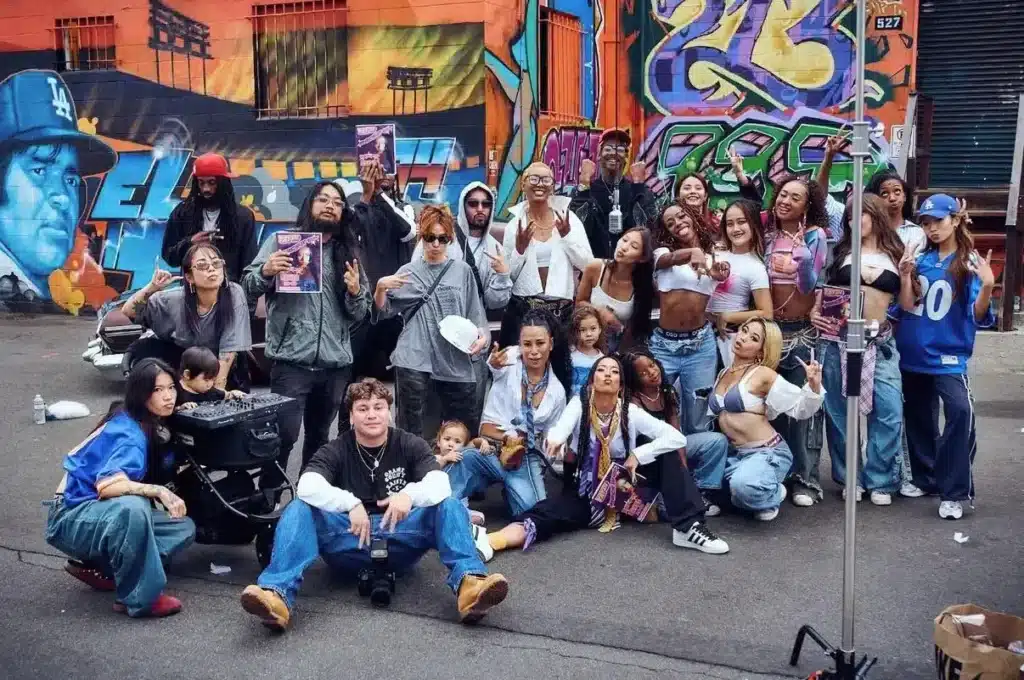
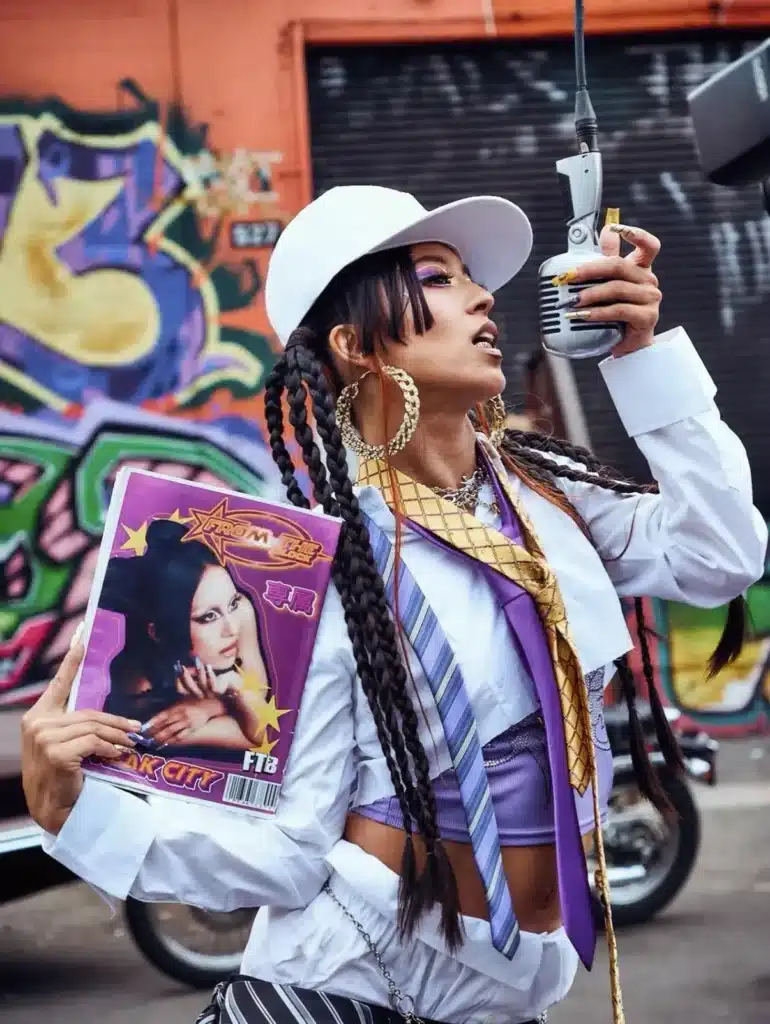
Yayoi: 4SHOOTERS, right. What I focused on. Hmm. I performed “Back It Up feat. Jenn Morel,” which I released last year. It’s a dance track, so I really wanted to commit to the dancing. It was the first time I’d danced hard through an entire song since “Makenna.” I hadn’t had a track where I was going all out with choreography for a while. This time, I wanted to dance — and I was most particular about the dance. But the thing is, I didn’t have any dancer friends in America. So I had to start from scratch — attending dance classes, spotting talented people, approaching them to ask if they’d be interested.
Originally, the featured artist Jenn Morel — she’s a Dominican Republic artist — was supposed to appear too. But she suddenly needed surgery and couldn’t make it. So the question became: do we postpone by six months? But we didn’t even know if the surgery would be fully healed by then — the vibes were getting uncertain. After talking it through with her, we made the call: I’d go solo, and lean fully into the Japanese angle. So instead of casting dancers of various backgrounds like I’d originally planned, I switched the main dancers to Japanese.
And the outfit I wore was designed to mix Japanese influences — like a school uniform vibe — with LA Lakers colors. The idea was that you could immediately tell I was Japanese. The whole thing took a lot of time. From assembling the team to everything else, it took about six months to produce. Since this is an Atlanta-based media outlet, there were flights to arrange for them, meetings to coordinate. It took time, but appearing on a respected American media platform for the first time — with a team I’d put together myself, and getting a proper video out of it — that was a major step forward.
Cook: Thank you. Your lyrics show how much you value your father and your family. Personally, I truly believe you’re a rapper who has carved her own path through sheer will. That challenger’s spirit is what makes you so cool to me. Including “Uta Daimon” — you’ve always done things where you couldn’t predict the outcome, and I believe that’s exactly why you arrived at 4SHOOTERS ONLY. It was meant to happen — I can see that watching your journey. If you had to sum up your musical roots — dancehall, R&B, hip-hop, Japanese reggae, the Osaka scene — are they all equally important?
Yayoi: Yes. All of them are precious to me. And the fact that you’ve even watched “Uta Daimon” — that makes me so, so happy. Thank you.
2026 and Beyond: Uniqueness Over Imitation
Cook: After the 4SHOOTERS ONLY experience, what are your goals or resolutions for 2026?
Yayoi: Hmm. “Back It Up” was a project I poured everything into — honestly, I’d made it expecting it to blow up big in America. The reality was, it didn’t reach that level. But appearing on a proper, established media platform for the first time, I felt my understanding of how I’m perceived as an artist deepen to another level.
To make it here, passion alone isn’t enough. You need uniqueness. You need that effortless cool — like Tyler, the Creator, doing wild, creative things but making it look completely natural. You have to reach that point where people feel authenticity, not just effort. Skilled, good-looking artists are everywhere here. Since moving to America, the nerves made me too serious, too rigid. This year, I want to break out of that shell… to reach a place where my uniqueness comes through naturally.
Sei: Cook, thank you! You said you’re releasing new music, right?
Yayoi: Spring and summer. Spring and summer are when things are moving. Being independent means there might be delays, but the plans are all in place.
A Message for HIPHOPCs Readers
Sei: Oh! That’s exciting. Last question — for young people who dream of taking on America and the world like you have, or any of our readers who might find it useful: any advice or message?
Yayoi: I haven’t achieved anything major in America yet, so I’m not really in a position to give advice. But one thing I can say: I deeply believe in not setting limits on yourself. If you can imagine it, it becomes reality. If you focus only on what’s currently possible in your current reality, the options may seem small. But if you can push all of that aside and find that exciting, heart-racing vision of where you truly want to be — and follow that excitement — you can break through any barrier.
Sei: That’s so cool. Following your excitement really is important. Thank you for such a long interview.
Throughout our conversation, parent-life chaos kept interrupting — her daughter threw toys and milk bottles, while my son ate the tangerines Yayoi had brought for her baby. But the relaxed, parent-to-parent atmosphere actually made for a warmer interview. Between the questions and answers, we got to glimpse Yayoi Daimon not just as an artist, but as a mother — navigating two identities, two countries, and two languages all at once. A rare and precious moment. Her spring and summer releases can’t come soon enough!
Thank you, Yayoi.
Photography provided by Yayoi Daimon
Yayoi Daimon Links:
Youtube / Official Website / Instagram