Translated by Sei
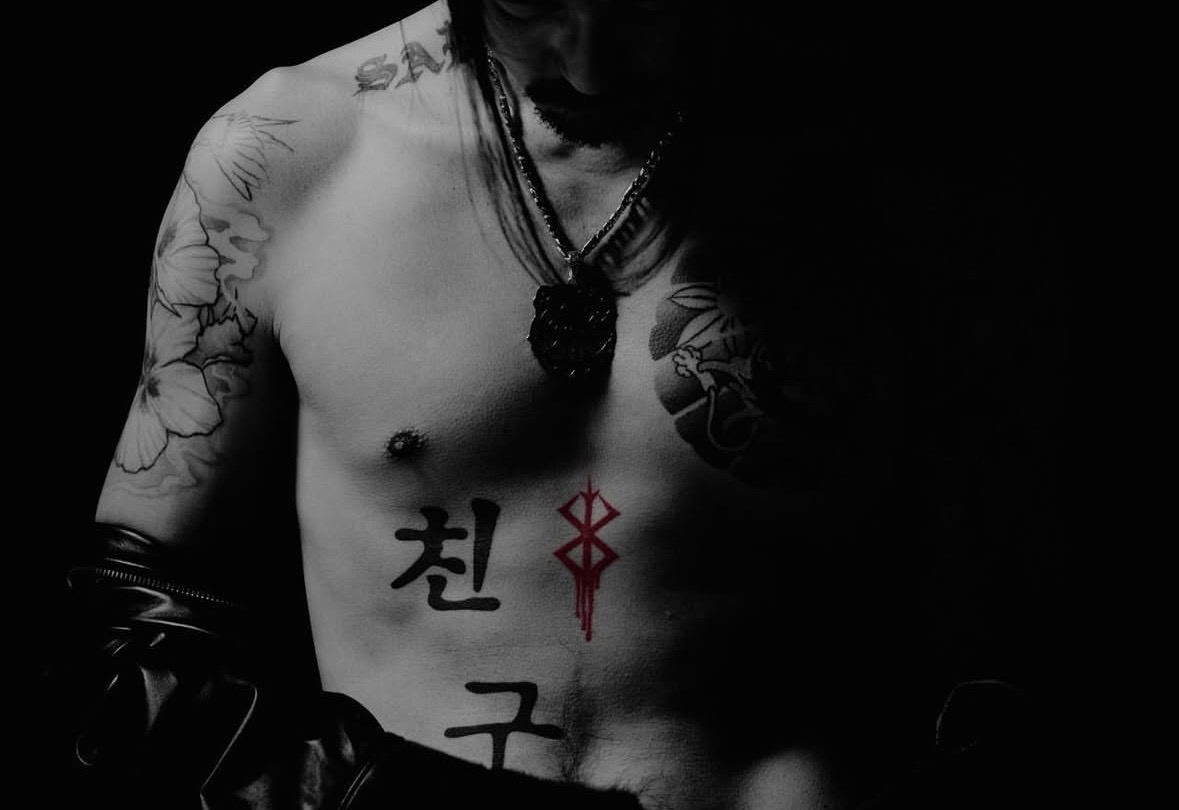
via @sadmadjake Instagram
It was around 2017 when Jin Dogg first started gaining recognition as a monster of the Kansai underground scene. I became definitively aware of his existence around that time, having encountered specific tracks: KID NATHAN’s “Chimi Moryo feat. Jin Dogg, Cold Rose & KilVViciouS” (2017), PETZ’s “Blue feat. Jin Dogg” (2019), and “Machi Kaze feat. REAL-T” (2020).
“Chimi Moryo” introduced a Jin Dogg enveloped in a madness capable of doing anything at any moment. “Blue” revealed a Jin Dogg expressing affection for a loved one intertwined with melancholy. And “Machi Kaze” showcased a Jin Dogg bearing the weight of his neighborhood, Ikuno-ku, and his feelings for his crew.
At first glance, these appear to be different facets of the artist, but listening to these three songs sequentially undeniably conveys that the core of Jin Dogg as a rapper is built upon three pillars: Madness (MAD), Pathos/Melancholy (SAD), and Love for his crew.
In this article, we will use these three songs as a starting point to trace Jin Dogg’s journey from 2017 to the present day (2025), contextualized within the Japanese rapcscene.
“魑魅魍魎 Chimi Moryo”—A powerful blow connecting Tokyo and Kansai, leaking spiritual energy
The Kansai monster who appeared through the window of KID NATHAN
The track “魑魅魍魎” (Chimi Moryo), featured on the 2017 EP “SPACE PARANOID” by TYOSiN (then known as KID NATHAN), presents a dark and unsettling atmosphere akin to a night filled with yokai (comprehensive term used in Japanese folklore for a wide range of supernatural entities and phenomena, including ghosts, demons, monsters, spirits, and shapeshifters), in both its beat and flow. Over this backdrop, Jin Dogg delivers verses in Japanese, Korean, and English, employing a powerful, almost shouting, tri-lingual flow. The author describes their initial reaction as feeling a shift in atmosphere upon hearing Jin Dogg, noting that his part elevates the track to a level of uncontrollable chaos with his unique voice and raw delivery. This track is seen as an early manifestation of the “MAD” side of Jin Dogg, which would become prominent in his later album “MAD JAKE”.
For this song Tokyo-based rapper KID NATHAN (now TYOSiN) collaborated with Jin Dogg, based in Kansai. This collaboration merged the atmospheres of Kansai, rooted in areas like Amemura and Ikuno, with Tokyo’s emerging dark trap scene. I view this track as a significant moment where the late 2010s Japanese dark trap movement became clearly defined, seeing Jin Dogg in the song as a Kansai dark hero entering the heart of Tokyo with destructive impulses.
The phrase “Blue feat. Jin Dogg” – The pathos residing in an ephemeral hook
An encounter with PETZ of YENTOWN
Following the lightning strike of Jin Dogg’s intensity in “Chimi Moryo (魑魅魍魎),” another song rose to prominence: “Blue.”
In September 2019, PETZ, a member of YENTOWN, released his first album, “COSMOS.” Included as the 12th and final track was “Blue feat. Jin Dogg,” produced by Bluxz. PETZ also operates as part of MONYPETZJNKMN and is known for collaborations with artists such as kZm, Awich, SANTAWORLDVIEW, and JP THE WAVY. Within his work, “Blue,” featuring Jin Dogg, possessed a special quality fitting for closing out the album.
An ephemeral hook and emotion that evokes a singalong
“Blue” showcases a completely different side of Jin Dogg compared to “Chimi Moryo (魑魅魍魎).” Feelings for a loved one, the frustration of being unable to convey love effectively, and regret for causing pain—these emotions gently yet surely resonate within the listener’s heart over a mellow beat.
The ephemeral hook sung by Jin Dogg carries a poignancy that tightens the listener’s chest. During the 2020 PETZ “COSMOS” release tour, the audience broke into a massive singalong during the “Blue” section, footage of which was later used in the beginning of the music video.
While Jin Dogg overwhelms the audience with madness in his other tracks, in “Blue,” he moves them to tears with pathos. For me, hearing this song made me realize, in a different sense than the fear felt with “Chimi Moryo (魑魅魍魎),” that this artist isn’t just intense, but capable of singing about the pain deep within his heart. From this point on, I fell completely into the world of Jin Dogg as an artist.
The background behind “Blue”
The reason Jin Dogg’s “Blue” resonates so deeply becomes clearer when you learn about his background.
Jin Dogg was born in 1990 and is a third-generation Zainichi Korean from Osaka’s Ikuno-ku ward. After moving around within Osaka during his early childhood, he moved to South Korea at age 10. Growing up, he confronted the pain of a fragmented identity—seen as Korean in Japan, yet Japanese in Korea, belonging nowhere.
It is this sense of displacement and loneliness, coupled with strong feelings for his family and crew, that I believe infuses “Blue” with an authentic pathos that no one else can.
“街風 Machi Kaze feat. REAL-T”—The winds of Ikuno-ku blow, proof of roots
Two voices resonating from Koreatown
After discovering the madness in “Chimi Moryo” and the pathos in “Blue,” the track that gave me a deeper understanding of Jin Dogg’s essence was “Machi Kaze(街風) feat. REAL-T” (2020).
This song is the result of Jin Dogg and REAL-T, both hailing from Ikuno-ku Koreatown, confronting each other with their respective lives and the history of their neighborhood.
The opening phrase, “This is Osaka, Ikuno-ku, Korean enclave,” starkly presents the reality of the town with unvarnished words. In the music video, the alleyways, shops, and overall atmosphere of Koreatown function almost as a character in their own right. The smell and temperature of the neighborhood, known only to those born and raised there—not the superficial, tourist-oriented facade—rise up from the entire video.
A song that crystallizes love for the neighborhood and crew
In “Machi Kaze,” Jin Dogg stands shoulder-to-shoulder with REAL-T, genuinely receiving and responding to his verse and intensity.
Rather than trying to stand out in the same way each time, he prioritizes the coolest form of himself for the group as a whole. He can adjust his position so that his collaborator’s strengths are maximized. It is because he has mastered this etiquette of collaboration that Jin Dogg has become a trusted figure among many rappers, regardless of whether they are from Tokyo or Kansai.
The success of “Machi Kaze” was a testament to the fact that Jin Dogg is both a rapper who can tell his own story and, simultaneously, a superb collaborator. Above all, this song is packed with gratitude and pride for the place he finally found belonging in, after having previously struggled with a sense of displacement.
The madness, pathos, and love seen in these three songs lead to“SAD JAKE / MAD JAKE”
In December 2019, Jin Dogg simultaneously released his first albums, “SAD JAKE” and “MAD JAKE”, as a double release. “SAD JAKE” brings forward the
introspective and emotional aspects, while MAD JAKE emphasizes the aggressive and combative sides of his artistry.
I believe that the concept of this two-part album is an expanded version of the multifaceted nature already presented in “Chimi Moryo,” “Blue,” and “Machi Kaze.”
“Chimi Moryo” is the prototype of the MAD side, while “Blue” and “Machi Kaze” are the prototypes of the SAD side. Furthermore, the way unstoppable destructive impulses, pain and pathos deep within the heart, and deep love for crew and community coexist without contradiction within one person is Jin Dogg’s greatest appeal.
Domestic music media also evaluated SAD JAKE / MAD JAKE as a contrast between sentimentality and madness, highlighting the work as one that elevated his position within the Japanese rap scene.
“Family Remix ft. Tha Jointz,” a song the author simply adores
Here, I would like to introduce a song that I personally love, from a slightly different angle than the flow of the three tracks mentioned earlier: “Jin Dogg – Family Remix ft. Tha Jointz.”
This track is an explosion of Jin Dogg’s passion and affection, particularly his love for his crew. The phrase in the lyrics, “My friends are family,” tells the whole story.
Valuing local companions who have shared joy and hardship as family, even more than blood relations. His honest and passionate humanity is expressed straightforwardly.
The featured artists, Tha Jointz, are a creative collective based in Osaka’s Amemura, just like Jin Dogg. Because this song was made not just through a business-like relationship, but with the genuine friends they spend their days with, the words carry an honest weight and warmth.
It is an anthem-like song that often sparks a massive singalong at live performances, including the audience. The ability to perform not only songs that cause intense mosh pits, but also tracks that deeply resonate with the heart—that is what I feel is Jin Dogg’s strength.
Jin Dogg’s Career Timeline—From “Chimi Moryo” to “Pain Makes You Better”
Looking back briefly at his career so far, using these three songs as an entry point:
The period of 2016–2017 was a time of emergence. He launched Hibrid Entertainment with Young Yujiro and released the mixtapes 1st High and 2nd High. He connected with the Tokyo scene by participating in KID NATHAN’s SPACE PARANOID on the tracks “Chimi Moryo” and “Curse Boyz.” It was also around this time that he garnered attention as a core figure in the Kansai trap movement, DIRTY KANSAI.
2019 was the year his dual nature became clear. He was featured on PETZ’s COSMOS with “Blue” and simultaneously released his first albums, “SAD JAKE” and “MAD JAKE”, on the same day. He also appeared in Red Bull Music × 88rising’s Asia Rising, establishing a presence within the Asian hip-hop context.
The years 2020–2021 brought the impact of “Machi Kaze.” Jin Dogg released the mixtape 3rd High “Kishikaisei” and the signature song “Machi Kaze feat. REAL-T,” which became a major topic of conversation, along with its music video, set in the Ikuno-ku Koreatown. The EP “You Don’t Know” was also released during this period.
In 2023–2024, his scope of activities greatly expanded. He released his second albums, “Blood & Bones (BLOOD) (2023)” and “Blood & Bones (BONES) (2024)”, as a two-part series. He made his film debut as the character Yasu in the movie “Sin Clock”, leaving a powerful impression. Under his own label, Dirty Kansai, he expanded into areas outside of music, including a collaboration with AVIREX and the ending theme song “NANI?” for the Netflix anime “Kengan Ashura”.
2025 is the year he grew into a nationwide headliner. He released his third album, “Pain Makes You Better”, and became a headlining presence at festivals and clubs not just in Kansai, but across the country. He also appeared as Kayaku, a member of the rapper group Nine Gates, in the ABEMA drama series “MOGURA”. He co-starred with Hannya and G-k.i.d on the original song “MOGURA -Hadasi no Mama de-,” further raising his profile as an actor.
Why you should still start with these three songs if you want to listen to Jin Dogg
In 2025, Jin Dogg’s discography has become quite extensive. Tracing back through the albums alone—”SAD JAKE” / “MAD JAKE”, “Blood & Bones (BLOOD/BONES)”, and “Pain Makes You Better”—provides a lot of information, making it quite hard to catch up all at once.
That is precisely why I would like to propose this: start with the three songs “Chimi Moryo,” “Blue,” and “Machi Kaze.”
The reason is simple: these three tracks package the very core of Jin Dogg—his madness (MAD), pathos (SAD), and love for his neighborhood and crew—in a raw, exposed form.
Touch upon that enigmatic energy in “Chimi Moryo.” Learn about the pain and melancholy that lie deep within that energy in “Blue.” Feel the love for the place and the friends he found by overcoming that pain in “Machi Kaze.” From there, if you follow the path to “SAD JAKE” and “MAD JAKE”, and then on to “Blood & Bones” and “Pain Makes You Better”, the story of Jin Dogg as a rapper should appear as a single, clear line.
Sin Clock and MOGURA—As an expressionist beyond just a rapper
His role as the hangure (half-gangster) Yasu in the film “Sin Clock” was Jin Dogg’s first appearance in a feature film. In the suspense noir starring Yosuke Kubozuka, he played a dangerous man possessing both madness and charisma, receiving high praise from film fans.
Furthermore, in 2025, he appeared as Kayaku, a member of the rapper collective “Nine Gates,” in the ABEMA drama series “MPD Narcotics Division MOGURA”. Alongside Hannya, G-k.i.d, RedEye, and CYBER RUI, he took on the role of bridging the gap between real hip-hop culture and the world of the drama.
He also demonstrated his presence as a peer to Hannya and G-k.i.d in the drama’s opening theme song, “MOGURA -Hadashi no Mama de-.”
What is important here is that in both roles, he doesn’t rely solely on the “Jin Dogg character”; he understands his role within the overall work and adjusts his expressions and vocal delivery accordingly.
The “human sincerity” that permeates the conversation with REAL-T
In the interview project featuring Jin Dogg and REAL-T, the two speak frankly about the history of Ikuno-ku, the light and shadow of Koreatown, their past arrests, and the choices they’ve made. What is impressive is that their narrative never attempts to romanticize themselves.
To REAL-T’s question, “What is hip-hop?”, he laughs and replies that he doesn’t know either. Stories of alcohol and drugs are told matter-of-factly, not as war stories, but in the context of choosing not to do them now. Regarding the history of discrimination in Ikuno-ku, they speak not just with victim consciousness, but with a forward-looking stance of continuing to do what they think is cool nonetheless.
Here, a posture of sincerely choosing how to live now, while carrying that intense environment on their backs rather than using it as a selling point, subtly emerges.
When viewed by collaborators or staff, this sincerity is a crucial factor. Not acting recklessly, keeping promises, engaging seriously with the work. This is why he is sought after for collaboration by performers in different fields, such as Yosuke Kubozuka and Hannya, as well as rappers from the same generation like REAL-T.
Jin Dogg is an excellent collaborator and a trustworthy person on set. That fact is clearly evident not only in his music, but especially in his interviews and documentaries.
Conclusion—Madness, Pathos, and Love: All of It Is Still Just the Beginning
Jin Dogg has become a presence that can no longer be fully described just within the frame of being a Kansai rapper.
His identity as a third-generation Zainichi Korean, his experience of being treated as an outsider in both Japan and Korea, the sense of belonging and community he found in the neighborhood of Ikuno-ku, and the history and present of Koreatown in Ikuno-ku made visible in “Machi Kaze”—all of these have become the flesh and blood of his music and acting.
The madness shown in “Chimi Moryo.” The pathos revealed in “Blue.” The reality of Ikuno-ku blowing through “Machi Kaze.” The love for his crew exploding in “Family Remix.” The new facets as an actor seen in “Sin Clock” and “MOGURA”. All of these mix together and culminate in the current 2025 work, “Pain Makes You Better”.
The title’s message, “Pain makes you better,” can be truly said to represent the very core of Jin Dogg as an artist.
Jin Dogg, the standard-bearer of Dirty Kansai born in Osaka’s Ikuno-ku. Madness and pathos, recklessness and sincerity, and deep love for his companions. His story continues on, balanced precariously upon these elements.
If you plan to delve into Jin Dogg’s work from now on, please start with those three songs: “Chimi Moryo,” “Blue,” and “Machi Kaze”!